
You give startups standard contract templates, a negotiation playbook with fallback positions and a simple approval process, so founders and sales teams can close routine deals without sending every contract to outside counsel.
Startups sign whatever the other side sends or wait days for outside counsel to review routine NDAs and order forms. Deals stall, and sales teams accept liability and payment terms that nobody tracks. WorldCC research from 2025 puts the value lost through weak contract practices at 5.4% of contract value.
Most early companies cannot afford a full-time general counsel, and outside firms bill every review by the hour. Nobody has the job of writing down the company’s standard positions, so the same negotiation repeats with each new customer.
You review recent signed contracts and the main deal types, then quote a fixed project fee under an engagement letter.
You draft the templates, a clause-by-clause playbook with fallback positions and an approval matrix.
You train the sales and operations team and offer a monthly retainer for escalations and updates.
They watch deals slow down in legal review and pay the outside counsel invoices.
A fixed project fee is easier to plan for than open-ended hourly review.
What buyers pay: Clio’s 2025 average for contracts work is $373 an hour. One firm’s flat fee for MSA drafting starts at $3,000. Fractional GC retainers run $1,500 to $15,000 a month.
Founders ask these groups who can fix a slow contract process.
There are 4 places to start, in the order most people find their first buyers.
Tell founders, sales leaders and finance leads you have worked with that you now build contract playbooks for a fixed fee.
Ask VC platform teams, fractional CFOs, contract software vendors and larger law firms to send you startups that are too small for them.
Attend Association of Corporate Counsel chapter events and startup gatherings, and speak on how in-house teams speed up sales contracts.
Post short breakdowns of common startup contract clauses and the fallback positions you recommend.
Every idea has weak spots. These are the ones to test before you spend money.
Advise outside clients only in states where you hold an active license, and check your state bar’s rules before you take a client.
Offer only process work, such as workflow, approval routing and contract software setup, and have a licensed attorney approve every legal position.
Read your employment agreement, get written consent for outside work, and turn down clients that compete or do business with your employer.
Carry malpractice insurance, define scope in each engagement letter, and adapt templates to each client’s state and deal type.
Want more ideas like this? Get all 50 remote-friendly ideas free →
Get inspired by the world’s coolest solo businesses, one story at a time. Delivered to your inbox, FREE. Join solo founders around the world getting the playbooks behind businesses run by one person.
You can unsubscribe with one click.
Start-up cost and time to first offer are our estimates. Prices come from the sources above and change over time, so check them before you set yours.
You are good at what you do, and you are tired of building someone else’s dream. But every idea you come up with feels too risky, too vague or too late. In 60 minutes, learn how to turn your skills into a solo business that makes bank so you can build your own dream.
We use cookies to run this site, understand how you use it and play embedded videos. Choose Accept All to allow all cookies, or Customize to pick the ones you allow.
Get 1 short lesson and 1 task a day by email. Finish all 5 and earn 10% off Plan A, our launch program, or the complete toolkit set, your pick.
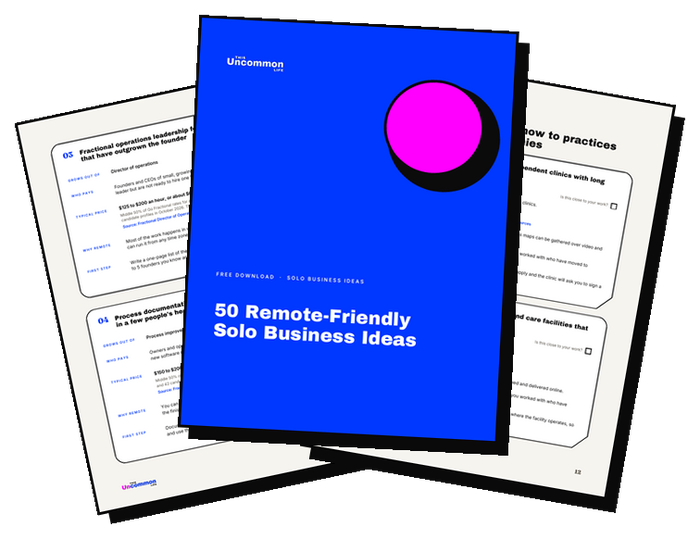
Each idea shows who pays, a typical price with its source, and a first step you can take this week.
Get a quick answer below, or message our team and a real person replies within 2 business days.
Tap a question for a quick answer.
A real person replies within 2 business days.