
You review 12 months of a mid-size company’s supplier spend and contracts, flag overpayments and weak terms, and hand the CFO or owner a ranked list of savings to act on.
Mid-size companies buy from hundreds of suppliers under contracts signed years ago by whoever needed the item. Prices creep up at renewal, auto-renew clauses lock in old terms, and duplicate vendors split volume that could earn a discount. One contingency firm reports average savings of 20% to 40% in categories such as telecom, waste and card processing fees, which shows how much slack sits in unmanaged spend.
The CFO knows spend is loose but has no one with the time or category knowledge to dig through invoices and contracts. Hiring a procurement director feels like too big a step, and contingency firms that keep half the savings for up to 5 years make owners wary.
You ask for 12 months of AP data and the top 20 contracts, then return 3 quick findings within a week.
You propose a flat-fee audit of the largest categories with a written deliverables list and a 4 to 6 week timeline.
You deliver a ranked savings list with supplier benchmarks and offer paid help to renegotiate the top items.
They own the P&L and see supplier spend as margin they can recover without cutting staff.
The fee comes out of expected savings, so a clear dollar estimate makes approval easier.
What buyers pay: $150 to $350 per hour, or 15% to 50% of verified first-year savings
These businesses carry large indirect spend in packaging, facilities, telecom, IT and freight, spread across many vendors.
There are 4 places to start, in the order most people find their first buyers.
Tell finance leaders and operators you worked with that you now run fixed-scope supplier audits, and ask who is under margin pressure.
Offer them a referral fee or a joint review for clients who ask how to lower operating expenses.
Speak at local Institute for Supply Management chapters, Vistage groups or chamber CFO roundtables about where supplier spend leaks.
Post short, anonymized breakdowns of what a single category review found and how the client fixed it.
Every idea has weak spots. These are the ones to test before you spend money.
Agree the baseline price, volume and period in writing before you start.
Limit scope to the top 20 suppliers or 80% of spend and list the data you need up front.
Present findings as benchmarks and let the client choose which contracts to reopen.
Check non-compete and confidentiality terms, and keep your current employer’s suppliers and data out of your work.
Want more ideas like this? Get all 50 remote-friendly ideas free →
Get inspired by the world’s coolest solo businesses, one story at a time. Delivered to your inbox, FREE. Join solo founders around the world getting the playbooks behind businesses run by one person.
You can unsubscribe with one click.
Start-up cost and time to first offer are our estimates. Prices come from the sources above and change over time, so check them before you set yours.
You are good at what you do, and you are tired of building someone else’s dream. But every idea you come up with feels too risky, too vague or too late. In 60 minutes, learn how to turn your skills into a solo business that makes bank so you can build your own dream.
We use cookies to run this site, understand how you use it and play embedded videos. Choose Accept All to allow all cookies, or Customize to pick the ones you allow.
Get 1 short lesson and 1 task a day by email. Finish all 5 and earn 10% off Plan A, our launch program, or the complete toolkit set, your pick.
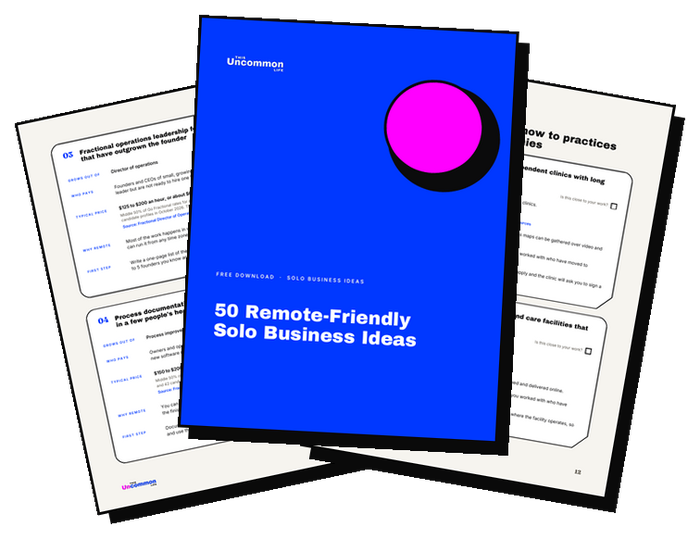
Each idea shows who pays, a typical price with its source, and a first step you can take this week.
Get a quick answer below, or message our team and a real person replies within 2 business days.
Tap a question for a quick answer.
A real person replies within 2 business days.