
You build a documented month-end close for a startup, with a checklist, reconciliations and a reporting package, so the founder gets reliable numbers within 10 business days.
Many startups take 15 days or more to close, often on a cash basis, with a bookkeeper who records transactions without reconciling accruals, deferred revenue or prepaid expenses. APQC benchmarks put the median close near 6 calendar days, so a slow close leaves founders sending investors stale or incorrect numbers.
Founders put off the fix because the books look fine until a fundraise, a first audit or a board meeting exposes the gaps. A full-time controller costs $180,000 or more a year, which feels like too large a step for a company under $5M in revenue.
You review the last 3 closes, the chart of accounts and the tools, then list what breaks and why.
You write the checklist, set up reconciliations and accrual schedules, and run the first close with the team.
You train the bookkeeper and offer a monthly review retainer to keep the process on schedule.
They sign investor updates and feel the pain when numbers change after they send them.
Investors and auditors ask for accrual-basis statements, which gives the founder a deadline and a reason to spend.
What buyers pay: $100 to $250 per hour; ongoing controller support runs $1,500 to $8,000 per month
Common triggers include closes longer than 10 to 15 days, a first audit, ASC 606 revenue questions and approaching $5M in ARR.
There are 4 places to start, in the order most people find their first buyers.
Tell founders, CFOs and former teammates that you set up month-end closes for early-stage companies.
Bookkeepers without controller skills and tax CPAs who see messy books can refer clients to you.
Offer a close workshop to accelerator cohorts or to VC portfolio finance programs.
Share a free close checklist or reconciliation template on LinkedIn and invite founders to ask questions about it.
Every idea has weak spots. These are the ones to test before you spend money.
Quote cleanup as a separate phase so the setup scope stays fixed.
List deliverables and an end date in the proposal and price monthly help separately.
Confirm the accounting stack before the build and document settings as you go.
Use a clear engagement letter and carry professional liability insurance.
Want more ideas like this? Get all 50 remote-friendly ideas free →
Get inspired by the world’s coolest solo businesses, one story at a time. Delivered to your inbox, FREE. Join solo founders around the world getting the playbooks behind businesses run by one person.
You can unsubscribe with one click.
Start-up cost and time to first offer are our estimates. Prices come from the sources above and change over time, so check them before you set yours.
You are good at what you do, and you are tired of building someone else’s dream. But every idea you come up with feels too risky, too vague or too late. In 60 minutes, learn how to turn your skills into a solo business that makes bank so you can build your own dream.
We use cookies to run this site, understand how you use it and play embedded videos. Choose Accept All to allow all cookies, or Customize to pick the ones you allow.
Get 1 short lesson and 1 task a day by email. Finish all 5 and earn 10% off Plan A, our launch program, or the complete toolkit set, your pick.
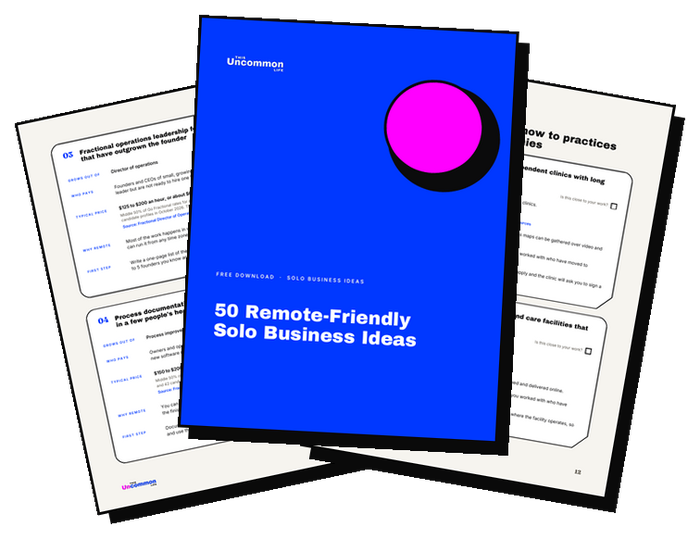
Each idea shows who pays, a typical price with its source, and a first step you can take this week.
Get a quick answer below, or message our team and a real person replies within 2 business days.
Tap a question for a quick answer.
A real person replies within 2 business days.