04Content That SellsGuide and fillable toolsDownload
Claim
Claim
Social media is the only advertising a solo business can run without a budget. You do not have to enjoy being on camera, but you do have to learn how a post earns attention and turns it into a conversation about working with you. This system turns what you know into posts that bring in clients, whether you make them yourself or hire a creator.
Not sure yet? Read the first part free →
When you start out, you usually have more expertise than money. Ads cost money before they tell you anything, while a post that works keeps bringing in viewers long after you publish it. The founders who get clients from social media treat it as a skill with parts you can learn.
A funny post or a trend can reach thousands of people and still bring in no inquiries. The people who enjoyed it were never going to buy, and nothing in the post told the ones who might buy what to do next. It feels like progress while the calendar stays empty.
Some posts exist to get seen. Some exist to be saved because they are useful. The ones that pay for everything else give a viewer a reason to trust you with their problem, and then an easy way to say so. Once you plan with all three jobs in mind, the likes stop being the scoreboard.
Full-time creators have to invent something to say every week. You already have years of client problems, mistakes you have watched people make, and methods you use without thinking. Every one of them is a post. What you need is the craft that makes a stranger stop and watch.
The first half is about making something worth watching. The second half turns that attention into sales, whether you film it yourself or pay a creator to film it for you.
A post can earn attention, get saved for later, or make the sale. Trying to do all three at once is how you end up with posts that do none of them. This part shows you the mix that grows an audience and still brings in clients.
Spreading yourself across five apps is the fastest way to post badly everywhere. The right first platform depends on who buys from you and how they like to learn. This part helps you commit to one, then reuse every video everywhere else without starting from scratch.
You do not need to invent a new kind of post. This part gives you a bank of proven formats in three families, short video, long form and text and graphic, and has you write your own version of each one before you film anything.
Viewers decide whether to keep watching almost immediately, and the platforms now report on it. A strong opening starts in the middle of a thought and gives the viewer a reason to stay. This part gives you a way to write several openings for every idea and pick the strongest.
People scroll past information. They stay for a story that has something unresolved in it, and they remember the lesson because they watched you learn it. This part gives you a simple story shape and helps you deliver it on camera in your own voice.
Most of what makes a video look amateur has nothing to do with the camera. It comes from light, sound, framing and a messy edit, and all four are cheap to fix. This part sets you up once so that every filming session starts ready.
A viewer who comments is raising a hand, and most founders leave that hand in the air. Comment automation replies in seconds with the thing you promised and moves the viewer toward a conversation with you. This part shows you how to set it up inside the platform’s rules without sounding like a bot.
You do not have to film everything yourself. Creators who make user-generated content (UGC), videos that look like a real person talking about a real problem, cost far less than most founders expect, and marketplaces now do most of the recruiting for you. This part shows you how to choose them, brief them and pay them.
Every part above has a tool attached to it, and The Content Planning Workbook holds your theme, story and format banks and your creator plan. You fill these in as you go, which is what makes this a toolkit and keeps it from being a course.
A month of posts, each one given the job of getting seen, getting saved or bringing in a client.
Your results, methods and the questions clients ask you, collected so each one can become a post a buyer trusts.
Where your buyers already spend their attention, scored so you commit to one platform first.
Proven formats in three families, with your own version of each written out before you film it.
Several opening lines for every idea, checked against what makes a viewer stay past the first seconds.
Your idea shaped into a short story with an opening, a gap, a realization, a lesson and a close.
Your light, sound, framing and editing settled once, so every filming session starts ready.
The keyword, the messages and the step to a booking link or offer, mapped before you switch the automation on.
The checks a creator’s own content has to pass before you pay them to make yours.
A brief that tells a creator exactly what to get across and leaves them free to make it their own.
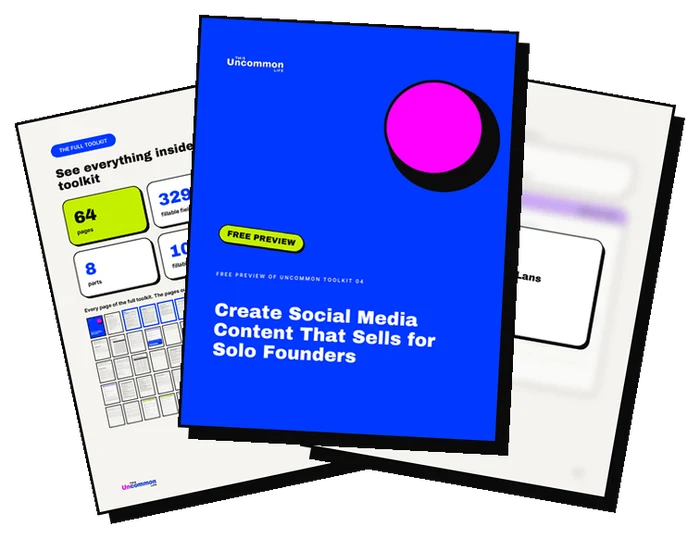
Get the opening, Part 1, its case study and the first page of Tool 01 free, sent to your inbox. The later pages are blurred, so you can see everything the full toolkit covers.
It is free, and you can unsubscribe with one click.
You will know what each post is for, how to open it so it gets watched, and how to tell a story a buyer remembers. You will have a filming setup that costs almost nothing, an automation that turns comments into conversations, and a brief you can hand a creator when you are ready to pay for help.
Not sure yet? Read the first part free →
Included in Plan A, our launch program, with the other 5 toolkits and 16 hours of 1:1 coaching.
Instant download, so the sale is final. If you buy the wrong toolkit, tell us within 7 days and we will move what you paid to the right one. We do this once per customer.
Your toolkit appears in the Downloads tab of your customer dashboard after you buy, so you can come back to it whenever a decision comes up.
Plan A includes all 6 toolkits and 16 hours of 1:1 coaching. You work through them against your own business over 8 weeks.
Every mentorship plan includes the Uncommon Toolkits. Paid monthly, you unlock 1 toolkit a month. Paid yearly, you get every toolkit after 30 days.
Each part explains the thinking behind a decision, shows case studies from several backgrounds and hands you a fillable tool to make it. A summary page holds your finished work.
It is written for one problem. If that is not the problem in front of you, something else here will help you more.
Every other toolkit here assumes buyers can find you. This one puts your expertise in front of them every week and gives them a way to reach you.
You get the complete set for $849 instead of $1,194 bought one at a time.
Plan A takes this material and the other 5 toolkits and runs them against your own business, on a fixed sequence with a real end date and a standard you have to reach to graduate. You come out with the business live and a plan for reaching its first customers that you can run on your own.
Plan A is our 8-week business launch program: 16 hours of live 1:1 time with a successful solo business owner to build and launch your own. Buy a toolkit now, and if you join Plan A within 60 days of your first toolkit purchase, everything you paid comes off the program fee.
What you paid comes off in full. Buy the complete set and all $849 comes off.
Buy any toolkit, or the complete set. Your 60 days start on your first purchase.
Apply to Plan A. Applying takes about 10 minutes.
Join within the 60 days. Your checkout link already takes off what you paid.

At 18, I moved from China, on a full scholarship, to the US with 3 suitcases, on my own. By my mid 20s, I was making over 6 figures at a Fortune 500 company in New York City and owned a home. I was winning in life, or so it seemed.
Deep down, I wanted to build my own dream, not someone else's. So I self-petitioned my EB-1A green card, planned my business on my lunch breaks, and within months quit to start a profitable-from-Day-1 education tech company as a first-time solo founder. Today, I run several solo expertise businesses while traveling the world.
This Uncommon Life is how I help you do the same: build your Plan A on your lunch breaks, so you never have to ask anyone's permission to take a vacation again.
Read my full story →Follow Stella
These reviews are about 1:1 mentoring with Stella, not about this toolkit. Reviews of the toolkit itself will appear here as buyers send them in.
My session with Stella was exceptionally informative and truly inspiring. She offered plenty of go-to-market strategies and tactics.
Highly recommend if you’re looking for a no-bullshit, warm, and all-in mentor for your startup.
Working with Stella Guan was eye-opening for our up-skilling platform.
Yes. Part 5 helps you speak to camera in your own voice, including reading from notes, and Part 3 covers formats where your face is not the main thing on screen, such as screen recordings, voiceovers and text posts. For an expertise business your face and voice build trust faster than anything else, so the toolkit helps you get comfortable in small steps. If you would still rather not appear at all, Part 8 covers hiring a creator to make the content with you.
Instagram, TikTok, YouTube long videos and Shorts, LinkedIn, Threads and X, with notes on Facebook and Pinterest. The toolkit helps you choose one to start with based on who buys from you, including when YouTube is the right home for a high-priced service, and then shows you how to adapt the same video for the others.
That toolkit decides where your business should show up at all: search, email, partnerships, events and social media. This one continues from it and goes deep on a single piece, making social media content that sells, from the first second of a video to the automation and the creators that turn it into clients. They work well together, and neither one repeats the other.
The phone you already own is enough. Part 6 shows you how to get good light and clear sound from what you have. If you buy one thing, make it a small microphone, because research shows viewers judge a speaker as less credible when the sound is poor.
It is neither. It is a written guide with 10 fillable tools built into it, plus a planning workbook for your themes, stories, formats and creators. The writing does the teaching: each part explains the thinking behind the decision, walks you through making it, shows you a real case, and then hands you the tool for that part. What you will not find is a video library, a login, a drip schedule or anything that expires.
A focused weekend gets you your platform, a month of planned posts, your filming setup, and your first hooks and stories drafted. The automation and creator parts get used once your posts start getting comments and when you are ready to pay for help, which is how they are meant to work.
What you paid here comes off the price of the set.
It is an instant download, so the sale is final. If you buy the wrong one, tell us within 7 days and we will move what you paid to the right one. We do this once per customer. That is why this page lists the contents part by part, names every tool inside, and says who should buy something else. If it has not convinced you that this is the problem you are stuck on, do not buy it.
We use cookies to run this site, understand how you use it and play embedded videos. Choose Accept All to allow all cookies, or Customize to pick the ones you allow.
The fillable toolkits cover what a business of 1 runs on: the model, the market, reaching buyers, closing them, selling through content, and staying lean and sustainable. The complete set is $849, which saves you $345 over buying them one at a time.
Get a quick answer below, or message our team and a real person replies, usually within a day.
Tap a question for a quick answer.
A real person replies, usually within a day.