
You build the handbook, core policies and onboarding process for companies of 10 to 100 people, so the founder has documented HR basics that meet compliance rules before problems start.
Small companies hire fast and run on unwritten rules. Federal obligations grow with headcount: the EEOC says Title VII and the ADA apply at 15 employees and age discrimination law applies at 20. The Department of Labor recovered more than $259 million in back wages for 176,957 workers in fiscal year 2025.
Founders put HR paperwork off until later, and a full-time HR hire competes with sales and engineering roles for budget. Free online templates miss state rules and how the company actually works.
You review headcount, the states where people work, current documents and open issues, then quote a fixed package.
You draft the handbook, core policies, onboarding checklist and required postings, and arrange review by an employment attorney.
You train managers on the new policies and offer an annual review or a monthly retainer for updates.
They handle HR on top of their main job and feel more exposed as headcount grows.
These moments make the risk visible and set a deadline.
What buyers pay: A new handbook from an HR consultant costs $1,000 to $5,000. US HR retainers run $500 to $5,500 a month. Upwork HR consultants have a median of $50 an hour, and advanced consultants charge $100 to $150+.
Small employers ask people they trust in these circles to recommend HR help.
There are 4 places to start, in the order most people find their first buyers.
Tell former colleagues and managers who have moved to small companies that you set up HR foundations for a fixed fee.
Build relationships with CPAs, payroll providers, insurance brokers and employment attorneys whose clients ask them HR questions.
Join your local SHRM chapter and chamber of commerce, and run short sessions on what changes at 15 and 50 employees.
Publish plain checklists of required policies and postings for the 1 or 2 states you know best.
Every idea has weak spots. These are the ones to test before you spend money.
Keep to HR practice, have an employment attorney review each handbook, and state that limit in your contract.
Start with 1 or 2 states you know, and follow a regular update source such as SHRM or each state’s labor department.
Sell customization, manager training and rollout, which templates do not include.
Offer an annual policy review or a small monthly retainer at handover.
Want more ideas like this? Get all 50 remote-friendly ideas free →
Get inspired by the world’s coolest solo businesses, one story at a time. Delivered to your inbox, FREE. Join solo founders around the world getting the playbooks behind businesses run by one person.
You can unsubscribe with one click.
Start-up cost and time to first offer are our estimates. Prices come from the sources above and change over time, so check them before you set yours.
You are good at what you do, and you are tired of building someone else’s dream. But every idea you come up with feels too risky, too vague or too late. In 60 minutes, learn how to turn your skills into a solo business that makes bank so you can build your own dream.
We use cookies to run this site, understand how you use it and play embedded videos. Choose Accept All to allow all cookies, or Customize to pick the ones you allow.
Get 1 short lesson and 1 task a day by email. Finish all 5 and earn 10% off Plan A, our launch program, or the complete toolkit set, your pick.
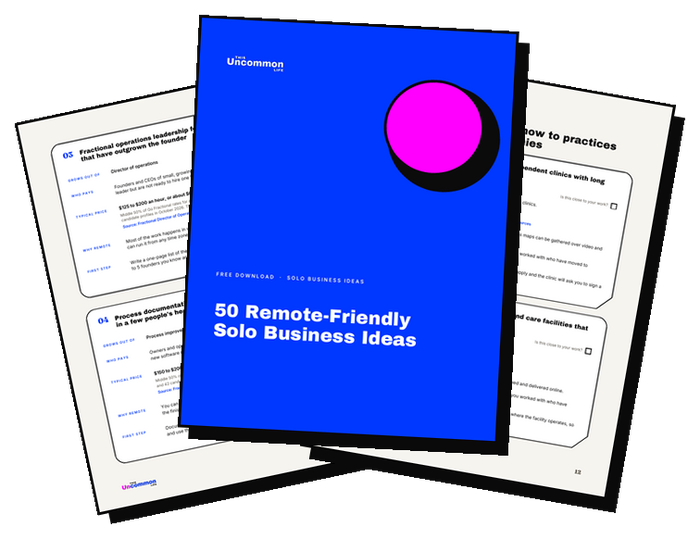
Each idea shows who pays, a typical price with its source, and a first step you can take this week.
Get a quick answer below, or message our team and a real person replies within 2 business days.
Tap a question for a quick answer.
A real person replies within 2 business days.