
You observe a clinic’s patient flow and staffing for 1 to 2 weeks and deliver a plan that shortens waits and eases the load on staff.
Staffing sits under every margin and access problem in a medical practice. In an August 2025 MGMA Stat poll of 343 practice leaders, the top priorities were margin and costs (41%), access and growth (26%), and staffing (20%), and MGMA ties all 3 back to staffing choices. Urgent care centers averaged 33.96 patients per day per center in 2025, so a 5 minute delay at rooming repeats dozens of times a shift.
Clinic leaders are usually physicians or administrators who run the schedule while seeing patients or chasing claims. Few small practices employ anyone whose job is to time each step of a visit, and health consulting firms often quote $25,000 or more for an operations review.
You ask the owner which number hurts most, such as wait time, overtime, or staff turnover.
You do a short paid walk-through and name 2 or 3 visible bottlenecks on the spot.
You sign a fixed-fee proposal and a business associate agreement, collect a deposit, and book observation days.
They answer for patient complaints, overtime spend, and provider productivity.
Owners weigh your fee against overtime, agency staff, and lost visits, which they already track.
What buyers pay: Nurse consultants bill $85 to $250 per hour (NNBA); practice consultants quote $5,000 to $25,000 per project (MedMan).
They lack an internal operations team and can change workflows faster than hospital systems.
There are 4 places to start, in the order most people find their first buyers.
Reach out to physicians, nurse practitioners, and administrators you have worked with who now run or manage clinics.
Partner with medical billing firms, healthcare accountants, and EHR consultants who already serve small practices.
Attend state MGMA chapter meetings and Urgent Care Association events where practice leaders gather.
Publish short case notes on cutting door-to-provider time or rooming delays on LinkedIn.
Every idea has weak spots. These are the ones to test before you spend money.
Sign a business associate agreement with each client, since HHS lists consultants who handle PHI as business associates.
Frame the work around their workload pain points and share findings with the team before the final owner report.
Keep your RN license active and send scope questions to the clinic’s counsel or your state board of nursing.
Carry professional liability insurance, since the NNBA notes an LLC does not relieve you of responsibility for your nursing actions.
Want more ideas like this? Get all 50 remote-friendly ideas free →
Get inspired by the world’s coolest solo businesses, one story at a time. Delivered to your inbox, FREE. Join solo founders around the world getting the playbooks behind businesses run by one person.
You can unsubscribe with one click.
Start-up cost and time to first offer are our estimates. Prices come from the sources above and change over time, so check them before you set yours.
You are good at what you do, and you are tired of building someone else’s dream. But every idea you come up with feels too risky, too vague or too late. In 60 minutes, learn how to turn your skills into a solo business that makes bank so you can build your own dream.
We use cookies to run this site, understand how you use it and play embedded videos. Choose Accept All to allow all cookies, or Customize to pick the ones you allow.
Get 1 short lesson and 1 task a day by email. Finish all 5 and earn 10% off Plan A, our launch program, or the complete toolkit set, your pick.
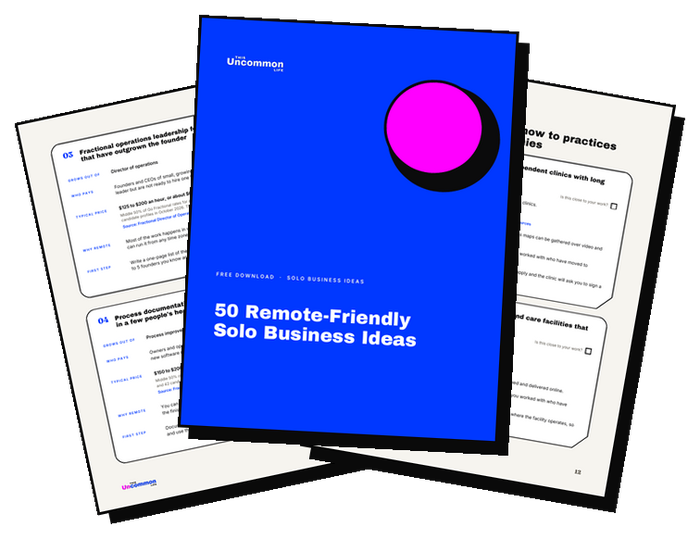
Each idea shows who pays, a typical price with its source, and a first step you can take this week.
Get a quick answer below, or message our team and a real person replies within 2 business days.
Tap a question for a quick answer.
A real person replies within 2 business days.