
You run a startup’s first searches from the job brief to the signed offer, on an hourly or monthly contract.
Small companies struggle to fill open roles. In NFIB’s June 2026 jobs report, 32% of small business owners had job openings they could not fill. Over half, 51%, reported few or no qualified applicants.
At a startup, the founder usually does the recruiting between product and sales work, so searches drag on. A full-time recruiter is a big hire, and Dover reports that contingency recruiters charge 15% to 25% of the new hire’s first-year salary.
You take on one hard-to-fill role on an hourly contract and agree on the profile, pay range and interview steps with the founder.
You map the next roles the startup needs, write the job briefs and set up a simple interview process the team can repeat.
You offer a set number of hours a week to run several searches at once, with regular pipeline reviews with the founder.
Dover notes that most teams need to move fast on 5 to 10 roles after a seed or Series A round.
An hourly or monthly fee is easier to plan than agency fees tied to each salary.
What buyers pay: $75 to $250 per hour, or $10,000 to $20,000 per month for 15 to 20 hours a week
These companies have fresh funding and a hiring plan, and many have no recruiter on staff.
There are 4 places to start, in the order most people find their first buyers.
Ask founders you know which role they have failed to fill for months. Offer to run that search on an hourly contract.
Offer the platform or talent teams at seed funds a short intro call with portfolio founders who are hiring.
Join accelerator and founder Slack groups and answer hiring questions with practical advice.
List your profile on marketplaces such as GoFractional, where startups post part-time roles.
Every idea has weak spots. These are the ones to test before you spend money.
Write down the role profile and must-have skills and get sign-off before you start sourcing.
Track your time for each search and agree on a monthly cap so the bill never surprises the founder.
Agree in writing what happens if a hire quits early, such as a free replacement search for a set period.
Read your current job’s non-compete and non-solicit clauses, and check your state’s rules on employment agencies before you ever charge per-hire fees.
Want more ideas like this? Get all 50 remote-friendly ideas free →
Get inspired by the world’s coolest solo businesses, one story at a time. Delivered to your inbox, FREE. Join solo founders around the world getting the playbooks behind businesses run by one person.
You can unsubscribe with one click.
You are good at what you do, but every idea you come up with feels too risky, too vague or too late. In 60 minutes, learn how to turn your skills into a solo business that makes bank.
You’ll also get The Solo File, our free newsletter. You can unsubscribe with one click.
We use cookies to run this site, understand how you use it and play embedded videos. Choose Accept All to allow all cookies, or Customize to pick the ones you allow.
Get 1 short lesson and 1 task a day by email. Finish all 5 and earn 10% off Plan A, our launch program, or the complete toolkit set, your pick.
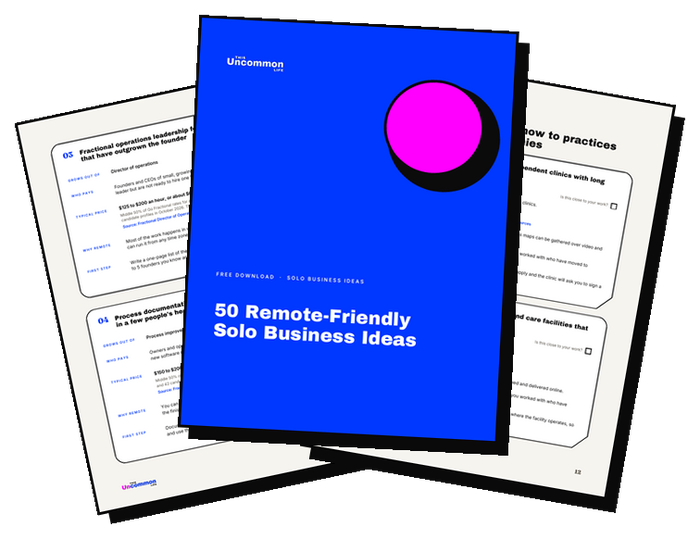
Each idea shows who pays, a typical price with its source, and a first step you can take this week.
Get a quick answer below, or message our team and a real person replies within 2 business days.
Tap a question for a quick answer.
A real person replies within 2 business days.