
You turn a company’s old onboarding and compliance slide decks into short interactive online courses that staff can take at their own pace from any office.
Onboarding at many companies is still a stack of slides that new hires click through or sit through in a meeting. Gallup reports that only 12% of US employees say their company does a good job of onboarding. Only 29% of new hires feel fully prepared and supported to excel after it.
The HR team knows the material is dull and out of date, but it has no course builder on staff. Building courses takes real time. Chapman Alliance research cited by Leading Learning puts the average at 79 hours of work for 1 hour of basic e-learning.
You review their current onboarding and compliance decks and show a short sample module built from 1 of them.
You propose a flat fee for the first course, with a script, a storyboard review and 1 round of changes.
You publish the course on their learning platform and offer to convert the rest of their decks in planned phases.
They own onboarding and compliance training, and they need every new hire to get the same training in every office.
Course building fits the learning budget, and a flat fee per course is easier to approve than an open hourly project.
What buyers pay: $100 to $150 per hour for experienced freelancers, sometimes up to $200 for specialized skills
Companies with many offices or steady hiring need the same training delivered to every new hire, wherever they start.
There are 4 places to start, in the order most people find their first buyers.
Tell HR and L&D leaders you have worked with that you now build onboarding courses, and show them your sample module.
Learning platform vendors and their resellers meet clients who bought a platform and have few courses to put on it.
Join your local Association for Talent Development chapter and share how you turned a slide deck into a short course.
Post a short before and after of a dull compliance slide and the interactive version you built.
Every idea has weak spots. These are the ones to test before you spend money.
Have their legal or compliance team approve the script before you build, since you design the course and they own what it says.
Fix the number of screens, the review rounds and the source material in your quote.
Ask which learning platform and file standard they use, such as SCORM, before you choose your authoring tool.
Check your current contract for IP and outside work terms, and build samples only from public material or your own.
Want more ideas like this? Get all 50 remote-friendly ideas free →
Get inspired by the world’s coolest solo businesses, one story at a time. Delivered to your inbox, FREE. Join solo founders around the world getting the playbooks behind businesses run by one person.
You can unsubscribe with one click.
You are good at what you do, but every idea you come up with feels too risky, too vague or too late. In 60 minutes, learn how to turn your skills into a solo business that makes bank.
You’ll also get The Solo File, our free newsletter. You can unsubscribe with one click.
We use cookies to run this site, understand how you use it and play embedded videos. Choose Accept All to allow all cookies, or Customize to pick the ones you allow.
Get 1 short lesson and 1 task a day by email. Finish all 5 and earn 10% off Plan A, our launch program, or the complete toolkit set, your pick.
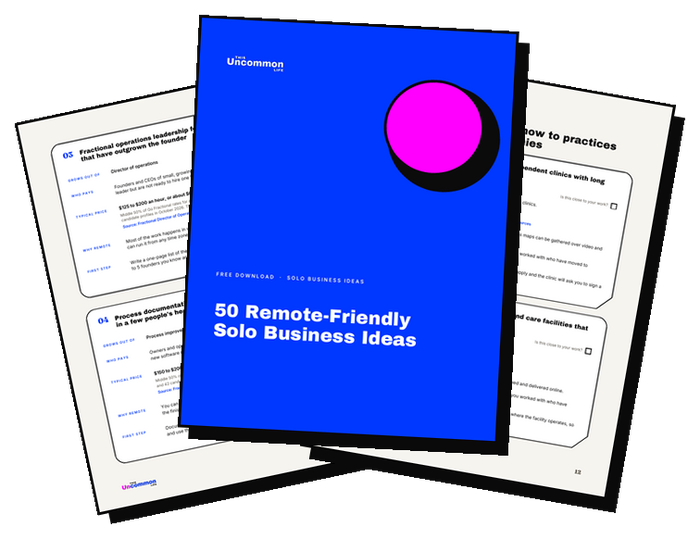
Each idea shows who pays, a typical price with its source, and a first step you can take this week.
Get a quick answer below, or message our team and a real person replies within 2 business days.
Tap a question for a quick answer.
A real person replies within 2 business days.