
You move a mid-size company’s contracts out of shared drives and spreadsheets into a contract management system, set up templates, approval steps and renewal alerts, and train the team to use it.
Contracts at mid-size companies sit wherever the signer saved them. In a 2025 Workday survey of 1,250 US employees, 70% of legal respondents said contracts sit in shared drives. About half said they had lost money to unintended auto-renewals.
Legal knows the files are scattered, yet the cleanup belongs to no single team. Finding every contract, pulling out key dates and building approvals stalls without an experienced lead. World Commerce & Contracting and Deloitte estimate that companies lose an average of 8.6% of the value of their contracts.
You review a sample of their contracts and folders, then return a short list of the risks you found, such as missed renewal dates.
You propose a flat-fee project to configure the system, migrate the contracts, record key dates and build approval workflows.
You train each team on the new process and offer a monthly retainer to keep the system clean and add new templates.
They answer for missed renewals and unknown obligations, and a clear system gives them control without hiring more staff.
Your fee can sit in the same budget as the software purchase, so tie it to getting full use out of that system.
What buyers pay: $178 per hour on average, with part-time retainers from about $5,000 per month
Mid-size firms that have just bought a contract tool, or are shopping for one, need help moving files and setting up workflows.
There are 4 places to start, in the order most people find their first buyers.
Tell legal, procurement and finance leaders you have worked with that you now run contract system setups, and offer them a free migration review.
Contact implementation partners and account managers at contract software vendors, who may need outside help to set up smaller customers.
Join World Commerce & Contracting or a local CLOC group and share what you learned from a contract system rollout.
Post your migration checklist and short notes on common mistakes, such as losing renewal dates during the move.
Every idea has weak spots. These are the ones to test before you spend money.
Deciding clause wording for a client counts as legal advice. Build templates from language their lawyer has approved and send drafting questions back to counsel.
Price the migration by contract volume after your free review, and set a limit on documents in the scope.
Agree with your sponsor to lock the old folders once the move is done, and train each team on its own contracts.
Ask early which tool they bought, and learn its setup well enough to show you can work inside it.
Want more ideas like this? Get all 50 remote-friendly ideas free →
Get inspired by the world’s coolest solo businesses, one story at a time. Delivered to your inbox, FREE. Join solo founders around the world getting the playbooks behind businesses run by one person.
You can unsubscribe with one click.
You are good at what you do, but every idea you come up with feels too risky, too vague or too late. In 60 minutes, learn how to turn your skills into a solo business that makes bank.
You’ll also get The Solo File, our free newsletter. You can unsubscribe with one click.
We use cookies to run this site, understand how you use it and play embedded videos. Choose Accept All to allow all cookies, or Customize to pick the ones you allow.
Get 1 short lesson and 1 task a day by email. Finish all 5 and earn 10% off Plan A, our launch program, or the complete toolkit set, your pick.
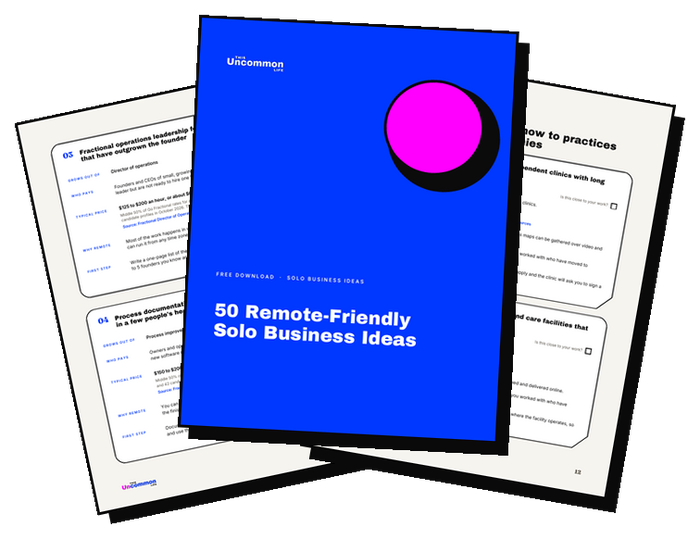
Each idea shows who pays, a typical price with its source, and a first step you can take this week.
Get a quick answer below, or message our team and a real person replies within 2 business days.
Tap a question for a quick answer.
A real person replies within 2 business days.