

If you are looking up how to start a business while working full time, you have probably run the numbers on leaving more than once. The salary pays for the life you built around it - the business you keep thinking about pays for nothing yet.
So you stay, and the gap feels a little wider every year.
You can close that gap on a normal working week. Build in a set order, and leave when the business reaches a number you chose in advance.
Short answer: Start while you are still paid. Read your employment contract, choose one direction, write who you help in one sentence and protect about 8 hours a week before work. Then ask a few people to pay you before you build anything, and decide in advance what monthly income means it is time to leave. You do not need a sabbatical, a career break or a gap in your income to start.
Key takeaways
- Build while you still have a salary, because founders who started on the side had much higher survival rates than those who quit first.
- Your employer spends close to a third of what it pays for you on benefits, so price them before you set a leaving number.
- Read your contract for IP, moonlighting and non-compete clauses before you start building.
- Choose one direction and write who you help in one sentence.
- Protect 2 hours before work on 4 mornings a week, roughly 400 hours a year.
- Ask 4 people to pay you before you build a website, and leave when the business hits the income you wrote down.
Build while you are still paid, because that route lasts longer
Joseph Raffiee and Jie Feng followed people who started a business while keeping their day job. In their Academy of Management Journal study, the ones who later went full time had much higher survival rates than people who quit first.
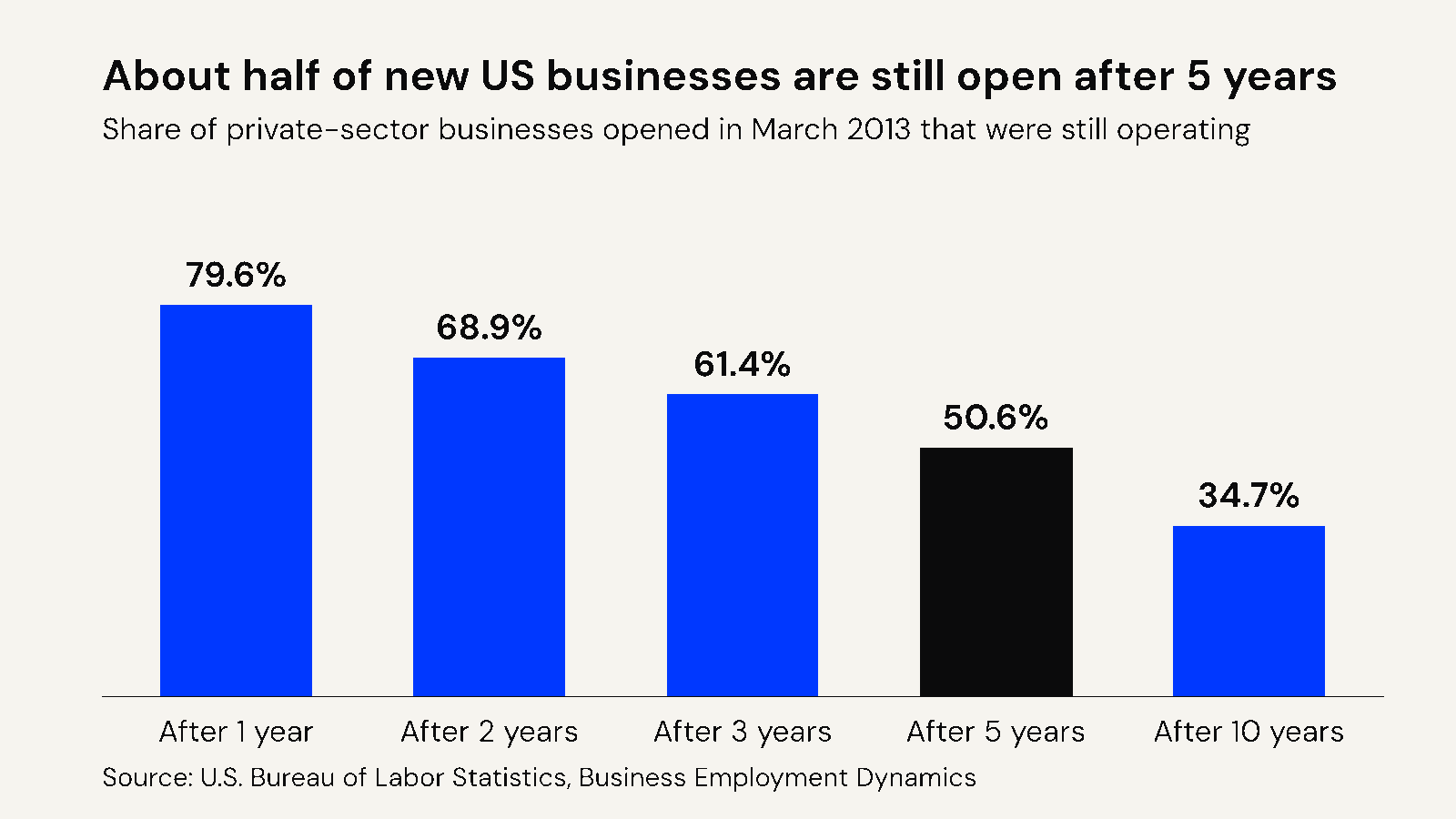
That matters, because most new businesses close within a decade. Of the US businesses that opened in March 2013, Bureau of Labor Statistics data shows 79.6% were still open a year later, 50.6% after five years and 34.7% after ten.
Test your idea while a salary still covers your rent. If it fails, you keep the lesson and the income.
Price what your job pays for that you will cover yourself
Your employer pays for things that never show up on your payslip. The day you leave, they become yours.
Stella Guan, the founder of This Uncommon Life, quit her job before the pandemic and found that health insurance was the cost she had not planned for.
Here is the United States version, because it is the most expensive one and the easiest to underestimate.
| What your employer pays for | The average figure | What happens when you leave |
|---|---|---|
| Benefits of every kind | $15.61 an hour on top of $33.85 in wages, close to a third of the total | You replace each benefit yourself or go without it |
| Health insurance, single coverage | $9,325 a year, of which the worker pays $1,440 | You pay the whole premium or buy your own plan |
| Social Security and Medicare | 7.65% from you and 7.65% from your employer | You pay the full 15.3% as self-employment tax |
If you live somewhere else, the mechanism is the same and the amounts differ. List what your employer pays on your behalf, such as health cover, a pension and social contributions. Then look up what each costs a self-employed person in your country.
The number the business has to beat is your real monthly spending, plus tax, plus those costs. That figure usually sits well below your gross salary.
Check whether a new job would fix what you hate about this one
Some of what makes a job hard to bear belongs to one company. A manager who times your lunch or a new strategy every quarter can end with a new employer.
Other problems come with being an employee anywhere. You stay reachable after hours, and you answer for decisions you were overruled on.
Those come from someone else having the final say over your work, so they follow you into the next job. If most of what you hate looks like that, a business of your own removes that.
Follow these steps to start a business while working full time
Each step fits around a full-time job, and each one depends on the one before.
1. Read your contract for IP, side-work and non-compete clauses
Open the agreement you signed on your first day before you start building, and look for these clauses.
| Clause | What it can do | What to check |
|---|---|---|
| IP or invention assignment | Give your employer rights to work you do on your own time | Whether it reaches work outside your employer’s business |
| Moonlighting or outside work | Require approval before you take paid work elsewhere | Whether you must ask in writing |
| Non-compete | Limit what you do after you leave | How long it lasts and whether your state or country enforces it |
In the United States, a federal court stopped the Federal Trade Commission’s 2024 non-compete ban. The FTC’s page on the rule (last updated April 20, 2026) says it is not in effect, so state law still decides. Other countries have their own rules.
This is general information, so take unclear wording to an employment lawyer. And keep every business file and account on devices you own.
2. Choose one direction before you spend an hour building
Holding three ideas feels like keeping your options open. In practice, every hour becomes an argument with yourself about which one to work on.
Choose the direction where you already have the skill and a problem you have solved for others more than once.
Finding the one direction worth committing to, and the reasons it beat the others, is what The Shortlist is for. It is a free 60-minute live workshop, and it is the step every other step here depends on.
3. Write down who you help in one sentence
Finish this sentence before anything gets built:
[Your business] helps [a specific kind of person] with [a specific problem] so they can [a specific outcome].
If the first blank says “small businesses”, keep narrowing. “Heads of operations at logistics companies with 50 to 200 staff” is specific enough to name four of them from memory.
Uncommon Toolkit
Work out what you sell before you start building
Decide what you sell, who buys it and what you charge, on pages you fill in rather than pages you read. That is How to Package Your Expertise into a Solo Business, built for a business of 1.
4. Protect 2 hours before work, 4 mornings a week
Evenings look free on paper, but after a full day of meetings most of that time goes to recovering.
Working 2 hours on 4 mornings gives you 8 hours a week of your best attention. That adds up to roughly 400 hours a year without a single day off. Put each block in your calendar with the task named, such as “Client outreach, 6am”.
Meanwhile, keep hitting your deadlines at work, so your manager has no reason to start watching you closely.
5. Ask 4 people to pay you before you build a website
The website, the logo and the registered company all feel productive. None of them tells you whether a customer will pay.
Go to 4 people who match your sentence and offer to do the work at a price, with a date. Charge from the first one, even a small amount. Kind words and a payment tell you very different things.
If all 4 say no, you have spent two weeks and learned what to change.
6. Set the monthly income that tells you it is time to leave
A savings goal that lives only in your head grows every time you get nervous. So write two numbers on one line.
The first is the monthly income the business has to reach: your spending, plus tax, plus what your employer covers today. The second is how many months in a row it has to hold. Once both are written down, you leave when the business hits them.
This exact order, worked through with you one on one in 8 weeks, is what Plan A does, for professionals with years of experience and no business built on it yet. Most founders in it are still in a 9 to 5.
Wait if your stock vests soon or the job is harming you
If stock options, a retirement match or a bonus vests within 12 months, work out what leaving early would cost. Pick your date with that figure in front of you.
If the job involves harassment or unpaid wages, talk to an employment lawyer before you resign. If it is affecting your health, see a doctor first.
This plan suits a business built on your expertise, such as consulting or coaching. A business that needs investors or a warehouse of stock needs a different plan.
Get help choosing the direction, the step that decides the rest
You have the whole method now. Choosing the direction decides whether the other steps are worth doing, and it is the step people most often get wrong on their own.
Recommended next step
Turn what you already know into something people buy
Work out what you sell, who buys it and what you charge, then write the offer in the words those buyers use. That is How to Package Your Expertise into a Solo Business, the fillable version of the hardest part of starting on the side.
Get the business chosen, set up and earning in 8 weeks
You work one on one on the direction you commit to, the business set up correctly underneath it, the positioning and the offer, and a plan for reaching the buyers you named. That is Plan A, our application-based 8-week program for professionals with real expertise and no business running on it yet.
Most founders in it are still in a 9 to 5, and it works the same way if you were laid off or you freelance. Working it out alone is possible, and it is also how people spend 2 years reaching an answer 8 weeks would have given them.
Work out what you should build, in 60 minutes
Come with too many directions and you leave with one, plus the reasons it beat the others. Come with none and you leave with a method for finding them. That is The Shortlist, our free live workshop for the choosing step on its own, and it is the first step into Plan A.