
Health insurance for self employed workers means buying a policy in your own name. The routes are few. The price is the whole question.
Most guides list the same handful of options, then leave you to find out what each one charges.
Here is what sets that price. Your premium comes from your income, your age and your zip code. Your medical history has no say in it. Which makes your first-year business plan a health insurance decision too.
Short answer: A marketplace plan is the default for most self employed people in the United States, and the price turns on your income rather than your health. Full price for one person runs several hundred dollars a month, and a tax credit cuts that if your income comes in under about $63,840. COBRA keeps your old plan at up to 102% of what it costs. An association or chamber plan is worth checking where you qualify.
Key takeaways
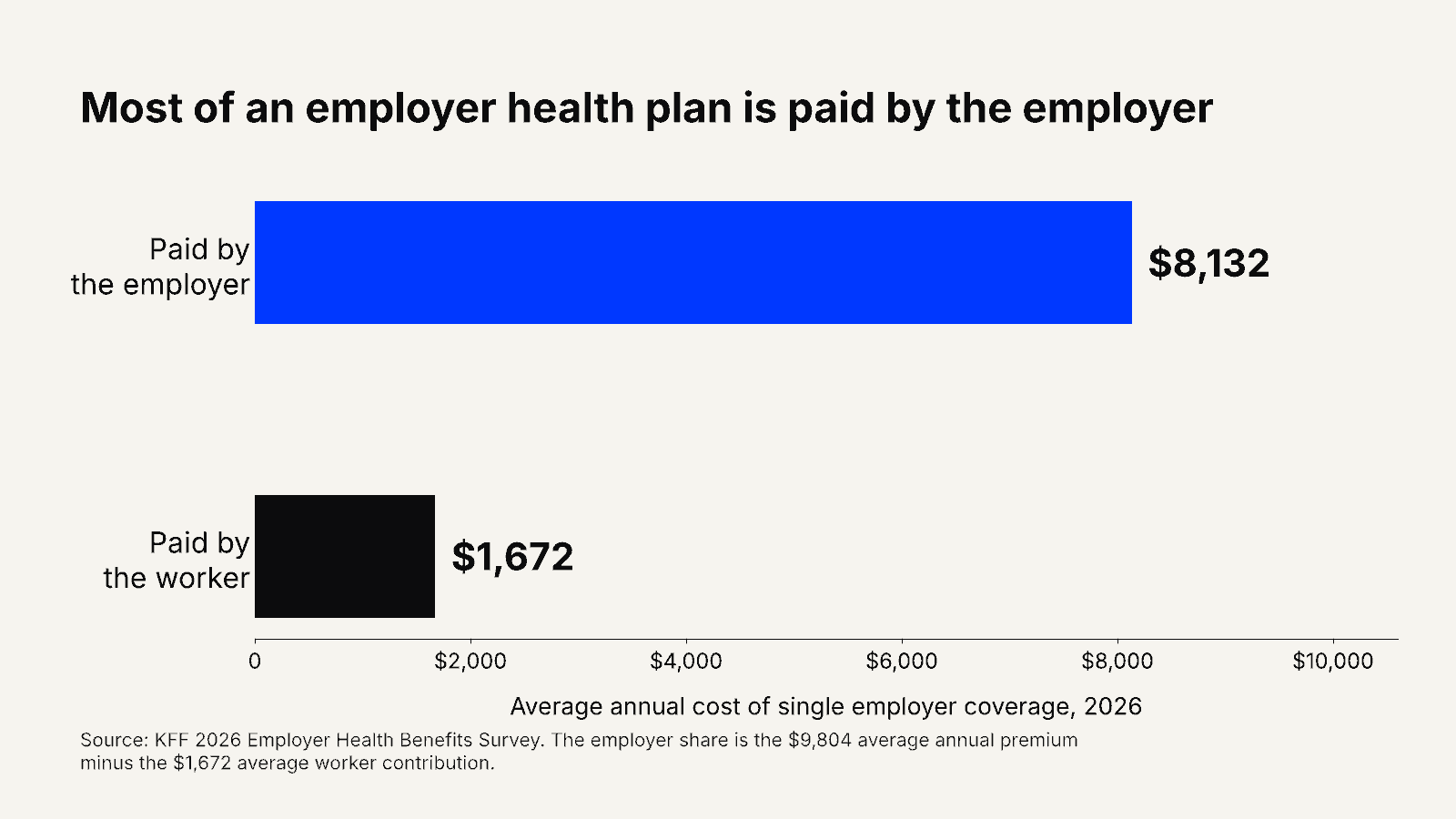
- If your cover came through a job, the employer was paying about $8,132 a year of it, and no payslip showed you that figure.
- Your income sets your premium and your medical history does not. So your income plan is part of the decision.
- The tax credit stops completely once income passes about $63,840 for one person. A few thousand dollars of extra profit can take more off you than it puts on.
- COBRA can charge up to 102% of what the plan costs, which makes it a bridge rather than a plan for the year.
- The deduction only reaches as far as the profit you made. A thin first year gives back thin relief.
- Price the cover before you price the work. It is a fixed bill the business has to earn on top of what you live on.
Why the first quote looks so much higher than you expected
If your cover came through a job, that plan was never as cheap as it looked. Single coverage cost $9,804 a year on average in 2026. The average worker paid $1,672 of it. The employer paid the rest, which works out at roughly $8,132 a year, says the KFF 2026 Employer Health Benefits Survey.
So the marketplace quote is the same bill - the whole bill - with your name on it now.
Those are the United States figures, because that is the most expensive version and the easiest to underestimate. The mechanism works the same way elsewhere. Find the two or three things an employer pays on your behalf where you live. Price them as a self employed person in your own country, and add that to your monthly number.
Prices are moving too. Insurers across all 50 states and DC asked for a median increase of 15% on 2027 plans, says the Peterson-KFF Health System Tracker. Price it again before you set what you charge clients.
Four ways to buy health insurance when you are self employed
Four routes are worth your time. Three are open to you wherever you live, and the fourth depends on what you do for a living.
1. A marketplace plan sets your price from your income
This is the default, and for most people it is the cheapest. You buy from healthcare.gov or your state’s own exchange. The insurer cannot turn you down or charge you more for your medical history.
Open enrollment for 2027 cover starts on November 1, 2026. Outside that window you need a qualifying event. Losing job-based cover is one, and it opens a 60-day special enrollment period.
What you pay turns on where you live, your age and what you earn. The cost of health insurance for self employed buyers swings widely between states for identical cover. So a figure a friend quotes you from another state tells you very little.
Run your own numbers on the exchange before you assume anything. Put in your zip code and the income you expect the business to make, and read the price with the credit already applied.
2. COBRA keeps your old plan and charges you all of it
If your cover came through a job, COBRA lets you stay on exactly that plan for a limited period. Same doctors, same deductible, same card in your wallet.
The catch is the price. The Department of Labor puts it in one line: you may be required to pay the entire premium, up to 102% of the cost to the plan. That is your old contribution, the employer’s share, and a 2% administration fee - the $8,132, arriving in one piece.
Two situations still make it the right call. One is being partway through treatment you do not want interrupted. The other is being close to a deductible you have already paid most of.
You get 60 days to decide, and cover is backdated once you elect it. So you can shop the exchange first and hold COBRA as the fallback. Put that 60-day deadline in your calendar the day the plan ends.
3. An association plan can beat the exchange in some fields
Professional bodies, trade groups and local chambers of commerce sometimes sponsor group cover for members. Freelancers Union runs plans in a list of states. Plenty of city chambers have done the same for years.
Whether it beats the exchange depends on the group and the state. Often it does not. Check anyway: the comparison takes 20 minutes and the gap runs to a few hundred dollars a month either way.
Read two things before you sign. Check that it is real insurance regulated by your state. Then check the network, because these plans sometimes buy a lower price by shrinking the list of doctors.
List the two or three bodies in your field and look up whether any of them sponsor a plan.
4. A high deductible plan cuts the monthly bill and raises the risk
A high deductible plan charges less each month and more when you use it. Paired with a Health Savings Account it doubles as a tax shelter. Money going in is deductible, and money coming out for medical costs is not taxed.
For 2027 the Internal Revenue Service set the self-only contribution limit at $4,500. A plan needs a deductible of at least $1,750 to qualify, under Revenue Procedure 2026-24.
This suits you if you use very little care and hold cash to absorb a bad year. It is the wrong choice if you take a regular prescription. You pay the full negotiated price until the deductible is met.
Add up what you spent on care over the last two years before you choose on the monthly figure alone.
| The route | What you pay | How long it runs | Who it suits |
|---|---|---|---|
| A marketplace plan | A premium set by income, age and zip code, less any tax credit | As long as you keep paying | Almost everybody, and the first place to look |
| COBRA | Up to 102% of the plan’s cost, employer share included | A limited period set by the plan | Mid-treatment, or near a deductible already met |
| An association or chamber plan | A group rate set by the sponsoring body | As long as you stay a member | Fields whose professional bodies sponsor real insurance |
| A high deductible plan with an HSA | A lower premium, against a 2027 deductible of $1,750 or more | As long as you keep paying | People who use little care and can absorb one costly year |
Recommended next step
Run the business lean enough to carry your own cover
You keep the running costs small and set the business up so its income covers them while it grows, premium included. That is How to Maximize Your Runway as a First-Time Solo Founder.
The income limit that decides whether you get help paying
Here is the part the other guides leave out.
A premium tax credit is worked out from the income you expect to make that year. The enhanced credits expired at the end of 2025, so the older limit is back in force. Pass 400% of the federal poverty line and the help stops completely.
For 2027 cover the marketplace reads the 2026 poverty guideline. The Department of Health and Human Services puts that at $15,960 for one person. Four times it is $63,840.
Crossing that line can take more off you than the extra income put on. Earn $63,000 and you may pay a few hundred dollars a month. Earn $65,000 and you pay the whole premium yourself - every dollar of it.
Two levers move the income figure the marketplace reads. The self-employed deduction comes off before that calculation. So does money you put into a Health Savings Account, up to $4,500 for 2027.
Work out the income you expect for the year before you price your first project, and check which side of $63,840 it puts you on.

The deduction gives some of it back, and only some
Premiums you pay for yourself come off your income as the health insurance for self employed tax deduction, claimed on Form 7206. It is an adjustment to income, so you get it whether or not you itemize.
Two limits matter more than the deduction itself.
It cannot run past what the business made. Your net earnings from the trade cap it, per the IRS instructions for Form 7206. A first year with thin profit gives back thin relief.
You also cannot claim it for any month you could have joined a subsidized employer plan. The test is whether a plan was offered to you, even if you never signed up for it.
So treat the premium as a full cost when you set your rates. Let the deduction be the good surprise in April.
Working this out by yourself is possible. It is also how people spend a year reaching a number that eight weeks would have settled. If you have years of expertise and no business earning from it yet, 16 hours of one on one coaching gets the direction chosen, the business set up underneath it and the first customers found. That is what the Plan A application opens.
Skip the cheapest plan if you take a regular prescription
Everything above assumes you are choosing on price. If you use the health system regularly, price is the wrong thing to choose on.
Celia Chen, a health strategist interviewed in How To Go Freelance, puts the trap in five words.
Health insurance is not healthcare.
Celia Chen, health strategist, in How To Go Freelance
A premium buys preventive care and protection against a catastrophe. Everything in between comes out of your pocket at the negotiated price until the deductible is met. The average single deductible on an employer plan was already $1,955 in 2026. On a cheap exchange plan it runs a good deal higher.
Four more routes exist, and each fails for a reason worth knowing. Medicaid is free where you qualify, and the income that brought you to this article almost certainly rules you out. Short-term plans are cheap because they can decline you for your medical history. Healthcare sharing arrangements are not insurance and carry no legal duty to pay your bill. Buying straight from an insurer outside the exchange costs the same or more and kills your tax credit.
Add up what you really spent on care over the last two years, and pick the plan that would have handled that year.
The part you should not work out by yourself
You came here for a number and you now have four of them, plus the income limit that moves all four. The step that decides whether any of it is affordable comes earlier. It is what the business charges and what it costs to run. That is the step people get wrong on their own, and it is the one we work on with you.
Recommended next step
Run the business lean enough to pay for your own cover
You price the work, hold the running costs down and set the business up so it sustains itself while it grows, premium included. That is How to Maximize Your Runway as a First-Time Solo Founder, at $199.
Get the business chosen, set up and earning in 8 weeks
If you have real expertise and no business running on it yet, we work with you one on one for 8 weeks. You settle the direction, set the business up correctly underneath it, get the offer and the price right, and reach your first customers. That is Plan A, application-based, with 16 hours of live 1:1 coaching and all 6 Uncommon Toolkits. Most founders in it are still in a 9 to 5, and it works the same way if you were laid off or you freelance.
Work out how long your savings last and what you must earn
You may not yet know what the business has to bring in each month to carry a premium like this. Six answers and about 90 seconds give you a 12-month plan in 3-month blocks, plus the months your savings realistically buy you. That is the Solo Founder Roadmap, free. It gives you the monthly number. Getting there in 8 weeks with somebody working on it beside you is what Plan A is for.