

Organic marketing strategies are the ways you reach buyers without paying a platform for the reach. That means search, your own content, other people’s audiences, email and referrals.
For a one-person business they are usually the only option that grows with effort instead of budget.
The problem is the advice.
Every guide that ranks for this gives the same 8 channels in no particular order: search, content, video, social, email, affiliates, public relations and user-generated content.
So the useful question is which of them work before you have an audience, and in what order.
Short answer: Start with the organic marketing strategies that need no audience. Tell the people who already know your work that you sell it now, and write down the exact words your buyers use for the problem. Then answer the narrow questions they search, publish on one channel you can keep up with, and ask each client for an introduction. Send the people who find you on social to a list you own.
Key takeaways
- Start with the people who already know your work, because it is the one strategy that needs no audience.
- Write down the exact phrases your buyers use, because those phrases become your page titles and your subject lines.
- Chasing a 2-word search term puts you against companies with hundreds of staff, so aim at questions of 4 to 7 words.
- Pick one channel you can still publish on in month 6, then make one piece of work serve several places.
- Referred clients earned about 25% more per day and stayed longer across 9,495 bank customers, so ask for the introduction as each project ends.
- Give every post a place to send people, because an email list is the only audience no platform can take away from you.
Most organic marketing advice is written for stores and teams
Read the guides that rank for this phrase and 2 things stand out. Nearly all are written for a store: giveaways, affiliate commissions, discount codes, social commerce. None of that applies when you sell a few engagements a year.
And none of them put the channels in an order. The biggest guides tell you to pick one and focus, then never say how to pick it.
The United States has 29.8 million businesses with no paid employees at all, against 8.3 million that do have them, according to the US Census Bureau.
If you are outside the United States, look up the same figure from your own statistics office. It is usually filed under sole proprietorships or businesses with no employees.
The split looks similar in most countries, and the point travels. Marketing advice gets written for the smaller group, the one with staff.
A channel plan built for a team breaks on one point - it assumes a second person keeps publishing while you do the work clients pay for.
Every hour you spend marketing is an hour you did not spend delivering, so rank the channels by what they return per hour.
| Strategy | Start it with no audience? | What it asks of you each week | What you keep if you stop |
|---|---|---|---|
| Tell the people who already know your work | Yes | A few messages | The relationships, still warm |
| Write down the words your buyers use | Yes | 2 conversations | A problem statement you reuse |
| Answer the narrow questions they search | Yes | One page written | Pages that keep getting found |
| Publish on one channel you can keep up with | Yes | One piece published | A body of work buyers can read |
| Make one piece of work serve several places | Yes | An hour of cutting up | More reach for the same effort |
| Publish where your buyers already read | Yes | One piece pitched | Introductions and links back |
| Ask a finished client for an introduction | After your first paid project | One ask, as a project ends | A short list of warm names |
| Run a short live session | Yes | An hour, once a month | A recording and the questions asked |
| Build an email list from your posts | Yes | One send you can sustain | The list, which no platform can take |
| Write finished work up as case studies | Yes, using work from your job | One write-up a month | Proof a buyer reads before calling |
The weekly figures come from what the practitioners linked below do in their own businesses. An organic marketing strategy for one person is mostly a sequence, and the sequence is what the big guides leave out.
Start with the organic marketing strategies that need no audience
1. Tell the people who already know your work that you sell it now
Your first paying client is almost always a former colleague, a former manager, or an old client contact.
Most people “tell their network” by posting an announcement. That reaches the followers they already have and asks for nothing.
Write down 10 names today. Send each one a short message naming the problem you now solve, and ask who they know who has it.
The message has to put one question to one person, because that is what gets answered.
2. Write down the exact words your buyers use for the problem
You cannot write a page that works until you know how your buyers describe the problem to themselves.
Richard Millington started the community consultancy FeverBee in 2008 with no contacts in the field. He recommends 25 interviews before you build the service, asking how big the problem is and what they do about it now.
That comes to 2 conversations a week for 3 months, and there is nothing to sell in them.

Write their phrases down word for word, because those become your page titles and your subject lines.
3. Answer the narrow questions your buyers type into a search bar
Search is the only organic channel where the work you do this month still brings people in 2 years.
The trap is aiming at the big phrases, where the ranking pages belong to companies with hundreds of staff.
You will not outrank them this year, or next.
A phrase with 30 searches a month from exactly your buyer beats one with 2,400 from the wrong reader.
Take the phrases from your conversations, keep the ones of 4 to 7 words, and write one page a week.
4. Publish on the one channel you can actually keep up with
Every guide leads with content, and they are right that it works. The part they skip is how much one person can keep up.
So pick one channel and one format: a written post, a short video, or a newsletter issue. Not all three.
Millington’s own rule is to build about a dozen strong resources and keep them current.
The channel you can still publish on in month 6 beats the one you start strong on and drop in month 2.
Write about the questions that came up in your conversations, one piece a week.
5. Turn one piece of work into several pieces of content
A solo business cannot feed 5 channels with new work. It can make one thing and cut it up.
One client question becomes a written answer, then a short video, then a post.
Millington found that publishing more posts gives diminishing returns quickly, which argues for depth over volume.
One piece of work in 3 places is the only content schedule that survives a busy month.
Before you make a new piece, take what you published this week and find 2 other places it can go.
Uncommon Toolkit
A tried-and-true marketing system you can plug and play
Set the channels up once, in the order on this page, and run them on the hours you actually have. That is How to Market Your Solo Business Without Ads, built for a business of 1.
6. Publish inside the places your buyers already read
You do not have to build an audience to reach one. Other people already have audiences full of your buyers, and most of them need a piece to publish.
That means guest posts, other people’s newsletters, podcasts in your field, and the communities where your buyers ask questions.
Pick 3 places, show up in all 3 for 6 months, and judge none of them before that.
Turn up with what you learned in your conversations.
7. Ask each finished client to introduce you to one person
Referrals appear on every list, and they have real research behind them.
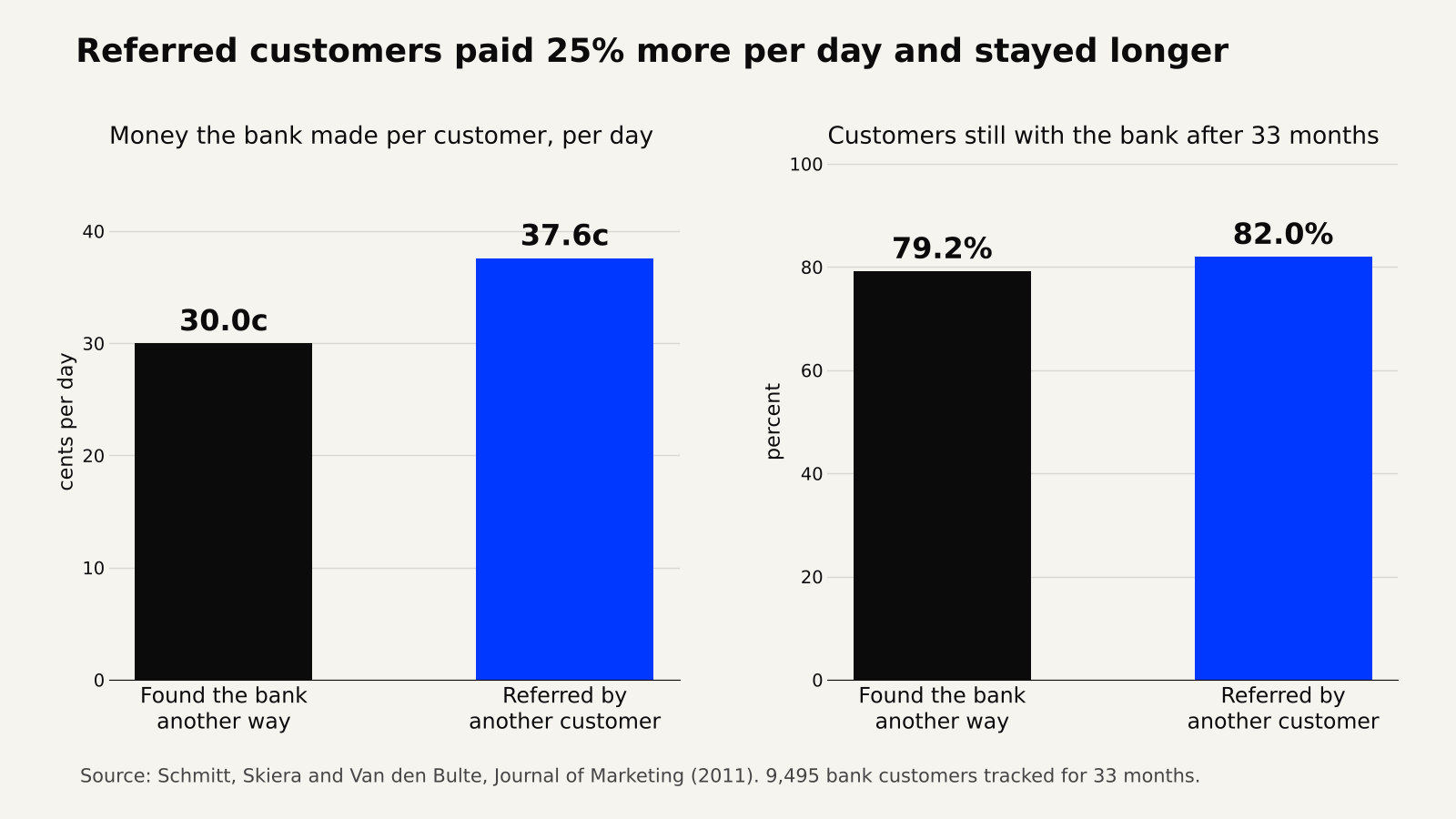
Researchers at Wharton and Goethe University tracked 9,495 customers of a German bank for 33 months.
Customers who came in through a referral earned the bank about 25% more per day. More of them were also still customers at the end, 82.0% against 79.2%.
The only thing is, a referral is not automatic money. A separate study of word-of-mouth referrals found that referred customers were less satisfied on average.
So ask for an introduction to one person whose problem you can describe.
A referral needs a finished project behind it, so this is the one that waits its turn. Telling the people who already know your work comes first, because that is what produces the client you will later ask.
8. Run a short live session on the question you get asked most
A live session is the only organic channel where you answer the objection as it comes up.
Millington runs 15 to 20 minute presentations built on one piece of data his audience does not have.

You do not need an audience for this - invite the 10 people you wrote down and post it twice where your buyers already talk.
Record it, because the recording keeps working afterward and the questions people ask tell you what to write next.
9. Turn the social posts you already write into subscribers
Every social platform decides how many of your followers actually see you. An email list is the one audience no platform can take back.
So run both. Keep posting where your buyers are, and give every post a place to send people who want more.
Pick a tool that stays free at low volumes, such as MailerLite, Kit or Buttondown, then put one sign-up form on the pages people land on.
The form needs a reason to fill it in that is worth more than “updates”. The checklist you run before a project works, or the one-page version of your method.
Then send on a rhythm you can hold, and write it to one person.
10. Turn each finished project into a case study buyers can find
A buyer wants to know whether you have done this before, for a company like theirs.
So write up each finished project: the situation, what you did, and what changed.
Use the work you did inside your job if no outside client has paid you yet. Leave the employer unnamed and the case study is still true.
A case study lets a buyer check whether their own situation is in there, which a page of testimonials never does. Put each one where a buyer reaches it before calling.
None of this works until you can say who you help and with what
Here is the part that stops most of these from working, and it has nothing to do with the channel.
You have to be able to say, in one sentence, who you help and what changes for them. Without it, every channel on this list carries a message your buyer cannot act on.
“But at this point, no-one cares about you (sorry!).”
Richard Millington, founder of FeverBee, on what fails when you start out
He means the most common opening move: promoting yourself when the service is the thing to promote.
The sentence that replaces it is short enough to write on a card.
[A specific kind of person] comes to you with [a specific problem] so they can [a specific outcome].
Getting that sentence right is the step people spend years circling alone. Settling it in 8 weeks, then building the business on top of it, is what Plan A does, for professionals with real expertise and nothing earning from it yet.
Fix the sentence first. Every channel gets easier after that.
How we help you set up this marketing faster and in the right order
You now have the order. The people who know you, the words your buyers use, the questions they search, the one channel you keep up with, and an introduction from every finished project. Running all of that as one system, with the hours you actually have, is the part that takes people a year to work out alone.
Recommended next step
Set up the marketing every solo business has to get right
Turn the work on this page into a system you run week by week, so what you publish this month still brings people in next year. That is How to Market Your Solo Business Without Ads, $199, downloaded straight away.
Work out what you should build, in 60 minutes
Come with too many directions and you leave with one, plus the reasons it beat the others. Come with none and you leave with a method for finding them. That is The Shortlist, our free live workshop for the choosing step on its own. Start there, then come back to the toolkit and run the channels on a direction that holds.