
You audit a B2B software company’s blog, find which posts bring sign-ups and which only bring traffic, and hand the head of marketing a content plan built around buyer questions.
Many software blogs rank for broad topics that attract students and curious readers. The posts that speak to buyers get little attention. An Ahrefs study of about 14 billion pages found that 96.55% get zero traffic from Google.
Only 29% of B2B marketers call their content strategy very or extremely effective, according to the Content Marketing Institute. In the same research, 56% said they struggle to tie content to ROI. The team keeps publishing to hit a quota, and no single role owns the link between posts and sales.
You compare a company’s top posts by traffic with its sign-ups or demo requests and send the head of marketing 3 clear findings.
You propose a flat-fee plan that maps buyer questions to keywords and lists which posts to update, merge or retire.
You deliver the plan with briefs for the first posts and offer a monthly retainer to guide writers and track results.
They answer for pipeline, and a blog that brings visitors without sign-ups is hard to justify at budget time.
Many teams already pay for writers and SEO tools, so a plan that makes that spend count fits a line they already have.
What buyers pay: $75 to $200 per hour, or $500 to $5,000 per month in total SEO spend
Software companies with a busy blog and a sales team asking for better leads feel this gap clearly.
There are 4 places to start, in the order most people find their first buyers.
Tell marketing leaders you worked with that you now build SEO content plans for B2B software companies, and ask whose blog is stuck.
Offer agencies that write or design for software firms a white-label plan they can add to their own work.
Join product marketing and SaaS marketing groups on Slack and LinkedIn and answer questions about content that brings sign-ups.
Post short, anonymized breakdowns of what a single blog audit found and which posts drove sign-ups.
Every idea has weak spots. These are the ones to test before you spend money.
Agree in writing on early signs of progress, such as rankings for buyer keywords, and avoid promising traffic numbers.
Ask for analytics and CRM access before you price the plan, and include basic conversion tracking setup if it is missing.
Include a short brief for each post and a review call with the writers so the plan gets used.
Check any non-compete or side-work clause, and avoid clients that compete with your employer.
Want more ideas like this? Get all 50 remote-friendly ideas free →
Get inspired by the world’s coolest solo businesses, one story at a time. Delivered to your inbox, FREE. Join solo founders around the world getting the playbooks behind businesses run by one person.
You can unsubscribe with one click.
You are good at what you do, but every idea you come up with feels too risky, too vague or too late. In 60 minutes, learn how to turn your skills into a solo business that makes bank.
You’ll also get The Solo File, our free newsletter. You can unsubscribe with one click.
We use cookies to run this site, understand how you use it and play embedded videos. Choose Accept All to allow all cookies, or Customize to pick the ones you allow.
Get 1 short lesson and 1 task a day by email. Finish all 5 and earn 10% off Plan A, our launch program, or the complete toolkit set, your pick.
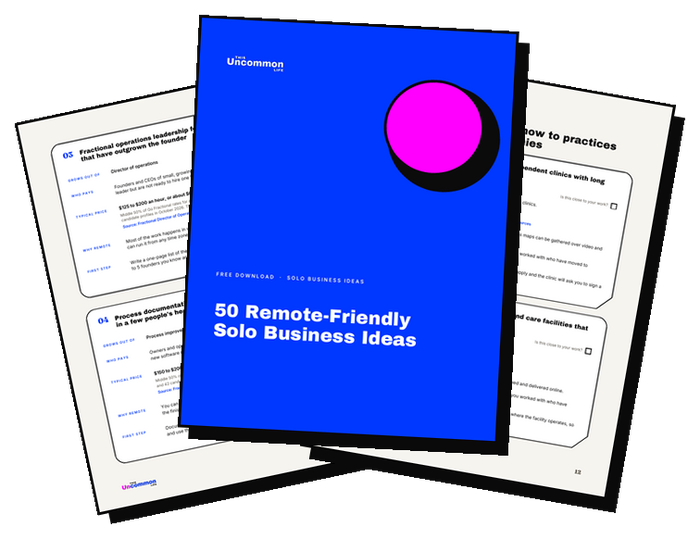
Each idea shows who pays, a typical price with its source, and a first step you can take this week.
Get a quick answer below, or message our team and a real person replies within 2 business days.
Tap a question for a quick answer.
A real person replies within 2 business days.