
You take a private practice’s new clinicians through insurance credentialing, from the CAQH profile to each payer application, and track every file until the insurer approves it.
Each insurer has to approve a new clinician before it will pay for that clinician’s visits. A 2021 MGMA Stat poll found 54% of medical practices said credentialing-related denials had gone up. MGMA also noted some payers were taking as much as 100 days to give a new provider an effective date.
The office manager often fits credentialing in between billing and the front desk, so applications stall and payer follow-ups slip. Medwave, a credentialing firm, estimates each application takes 10 to 20 hours per provider per payer.
You check one new clinician’s CAQH profile and payer list, then send back the missing items and the order to apply in.
You quote a flat fee for each payer application and submit them, with a shared tracker that shows the status of every file.
You offer a monthly fee per provider to handle recredentialing, CAQH updates and roster changes as they come due.
The practice cannot get paid for a new clinician’s visits until each payer approves, so every delay hits cash flow.
The fee is small next to the new clinician’s salary, and the practice wants that clinician billing as soon as possible.
What buyers pay: $100 to $300 per payer application, or $50 to $200 per provider each month for upkeep
Growing practices add clinicians often, and each new hire has to be credentialed with every payer the practice accepts.
There are 4 places to start, in the order most people find their first buyers.
Tell practice managers and medical staff colleagues you worked with that you now take new clinicians through payer credentialing for a flat fee per application.
Offer billing firms a referral fee for clients whose new providers are stuck waiting on payer approval.
Join your state MGMA chapter and offer practice administrators a short talk on the most common reasons payer applications stall.
Answer credentialing questions in LinkedIn and Facebook groups for therapy and private practice owners, and offer a free file review.
Every idea has weak spots. These are the ones to test before you spend money.
Tell each client in writing that you control how fast and how cleanly you submit, and that the payer decides when approval comes.
You will hold ID numbers, license copies and malpractice details. Use an encrypted file share and sign a confidentiality agreement with each client.
Use a checklist for each payer and have the clinician confirm every detail before you submit.
Credentialing work needs no license, so the main check is any non-compete or outside-work clause with your current medical group or hospital.
Want more ideas like this? Get all 50 remote-friendly ideas free →
Get inspired by the world’s coolest solo businesses, one story at a time. Delivered to your inbox, FREE. Join solo founders around the world getting the playbooks behind businesses run by one person.
You can unsubscribe with one click.
You are good at what you do, but every idea you come up with feels too risky, too vague or too late. In 60 minutes, learn how to turn your skills into a solo business that makes bank.
You’ll also get The Solo File, our free newsletter. You can unsubscribe with one click.
We use cookies to run this site, understand how you use it and play embedded videos. Choose Accept All to allow all cookies, or Customize to pick the ones you allow.
Get 1 short lesson and 1 task a day by email. Finish all 5 and earn 10% off Plan A, our launch program, or the complete toolkit set, your pick.
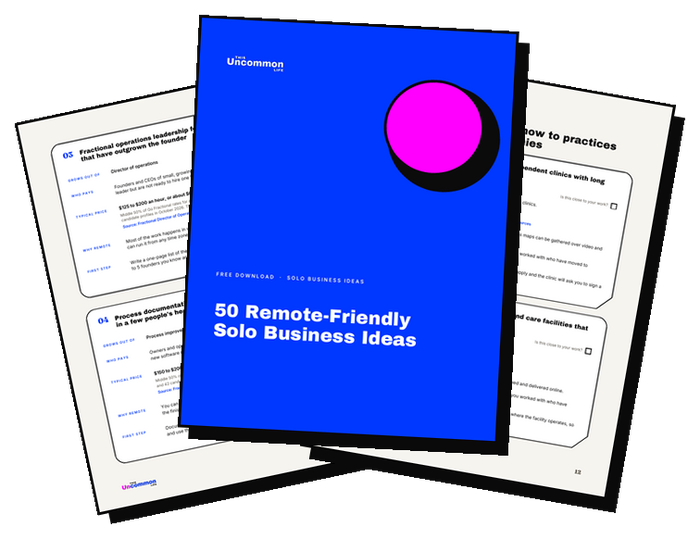
Each idea shows who pays, a typical price with its source, and a first step you can take this week.
Get a quick answer below, or message our team and a real person replies within 2 business days.
Tap a question for a quick answer.
A real person replies within 2 business days.