
You rebuild a leadership team’s board and investor slides so each page makes 1 clear point, then hand over a template they can reuse for the next meeting.
Board decks grow as each team adds its own slides, and the main message gets buried. In Board Intelligence’s board pack self-assessments, 54% of board members and governance professionals said key messages are hard to find. In a separate study with the Society for Corporate Governance, 50% of organizations had heard from directors that meeting materials were too long.
Investor decks face the same problem with even less attention. DocSend data shows investors spend less than 3 minutes reviewing a pitch deck. The chief of staff who pulls the slides together rarely has design help on hand.
You redesign 3 slides from their last board or investor deck and walk the CEO or chief of staff through the changes on a call.
You quote a flat fee for the next deck, with a draft review and 1 round of changes before the meeting date.
You hand over a master template and a short style guide, and offer a retainer for each board deck after that.
They stand in front of the board or investors, and a clear deck keeps the discussion on strategy.
Board and fundraising decks are high-stakes, so a fixed price per deck tied to a meeting date is easy to approve.
What buyers pay: $1,500 to $5,000 or more per deck at agency level, or $500 to $1,500 from senior freelancers
These companies report to boards and investors on a regular schedule and often raise money, so they need high-stakes decks again and again.
There are 4 places to start, in the order most people find their first buyers.
Tell executives and chiefs of staff you have worked with that you now redesign board and investor decks, and share a before and after.
Fractional CFOs build board reporting for several clients and can bring you in to design the slides around their numbers.
Join chief of staff groups on LinkedIn or Slack and share short tips on making a board deck easier to follow.
Redesign a public investor presentation from a listed company in your old industry and post the before and after.
Every idea has weak spots. These are the ones to test before you spend money.
Sign an NDA before you see any draft, and if the company is listed, follow its rules on nonpublic financial results.
Set the draft and final dates against the meeting date in your quote, and price rush changes separately.
Ask for the 3 decisions or messages the deck must get across before you design a single slide.
Check your current contract for non-compete and outside work terms before you take clients in your old industry.
Want more ideas like this? Get all 50 remote-friendly ideas free →
Get inspired by the world’s coolest solo businesses, one story at a time. Delivered to your inbox, FREE. Join solo founders around the world getting the playbooks behind businesses run by one person.
You can unsubscribe with one click.
You are good at what you do, but every idea you come up with feels too risky, too vague or too late. In 60 minutes, learn how to turn your skills into a solo business that makes bank.
You’ll also get The Solo File, our free newsletter. You can unsubscribe with one click.
We use cookies to run this site, understand how you use it and play embedded videos. Choose Accept All to allow all cookies, or Customize to pick the ones you allow.
Get 1 short lesson and 1 task a day by email. Finish all 5 and earn 10% off Plan A, our launch program, or the complete toolkit set, your pick.
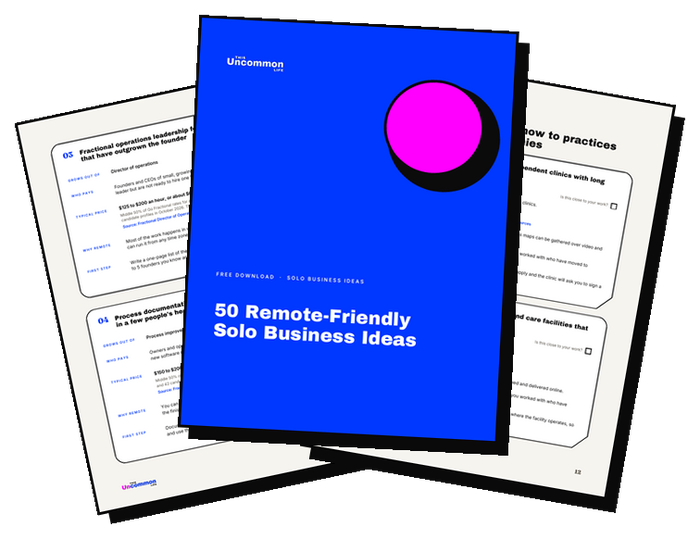
Each idea shows who pays, a typical price with its source, and a first step you can take this week.
Get a quick answer below, or message our team and a real person replies within 2 business days.
Tap a question for a quick answer.
A real person replies within 2 business days.