

GoHighLevel sells 1 subscription that replaces a CRM, an email tool, a text message tool, funnels, forms and calendars. This GoHighLevel review works out what that is worth to 1 person selling their own expertise.
The review pages ranking for it answer a different question. They price the platform against an agency running 10 client accounts and reselling the software under its own name. The 2 most detailed of them also earn a commission when you sign up, and say so.
At a business of 1 there are no client accounts to resell, and no margin to make on another company’s subscription.
So here is what GoHighLevel charges and what the usage fees come to at solo volume. Then there is what the same jobs cost on the free plans of 4 separate tools.
Short answer: GoHighLevel earns its price when you run marketing for other businesses, because the client sub-accounts, white-label and resale features are what you pay for. For 1 person selling their own expertise, the cheapest plan is $97 a month, or $1,164 a year. The free plans of Kit, Calendly, HubSpot and Stripe cover the same jobs. The usage fees every review warns about come to roughly $8 a month at solo volume. The expensive part is the 2 to 4 weeks of setup you spend before a single customer exists.
Most GoHighLevel Review Pages Are Written For Agency Owners
GoHighLevel’s own pricing page sorts its plans by how many other businesses you run inside it.
The $97 plan is labeled “For one business or a few clients” and caps you at 3 sub-accounts. The $297 plan is “For agencies managing unlimited clients.” The $497 plan adds “SaaS mode with unlimited reselling.”
A sub-account is a separate, walled-off copy of the whole platform for 1 client. White-label puts your name on the software so your client never sees GoHighLevel. Reselling means you charge that client a monthly fee for software you rent at wholesale.
Those 3 things are the business model, and a business of 1 uses none of them.
The billing follows the same logic. GoHighLevel’s pricing guide says passing usage charges on to a client only works on the $297 and $497 plans. The feature assumes there is a client to pass them to.
GoHighLevel Pricing Starts At $1,164 For The Year
There are 3 published plans, billed month to month with no contract.
All 3 carry unlimited contacts and unlimited users - that part is unusual at this price and worth saying out loud.
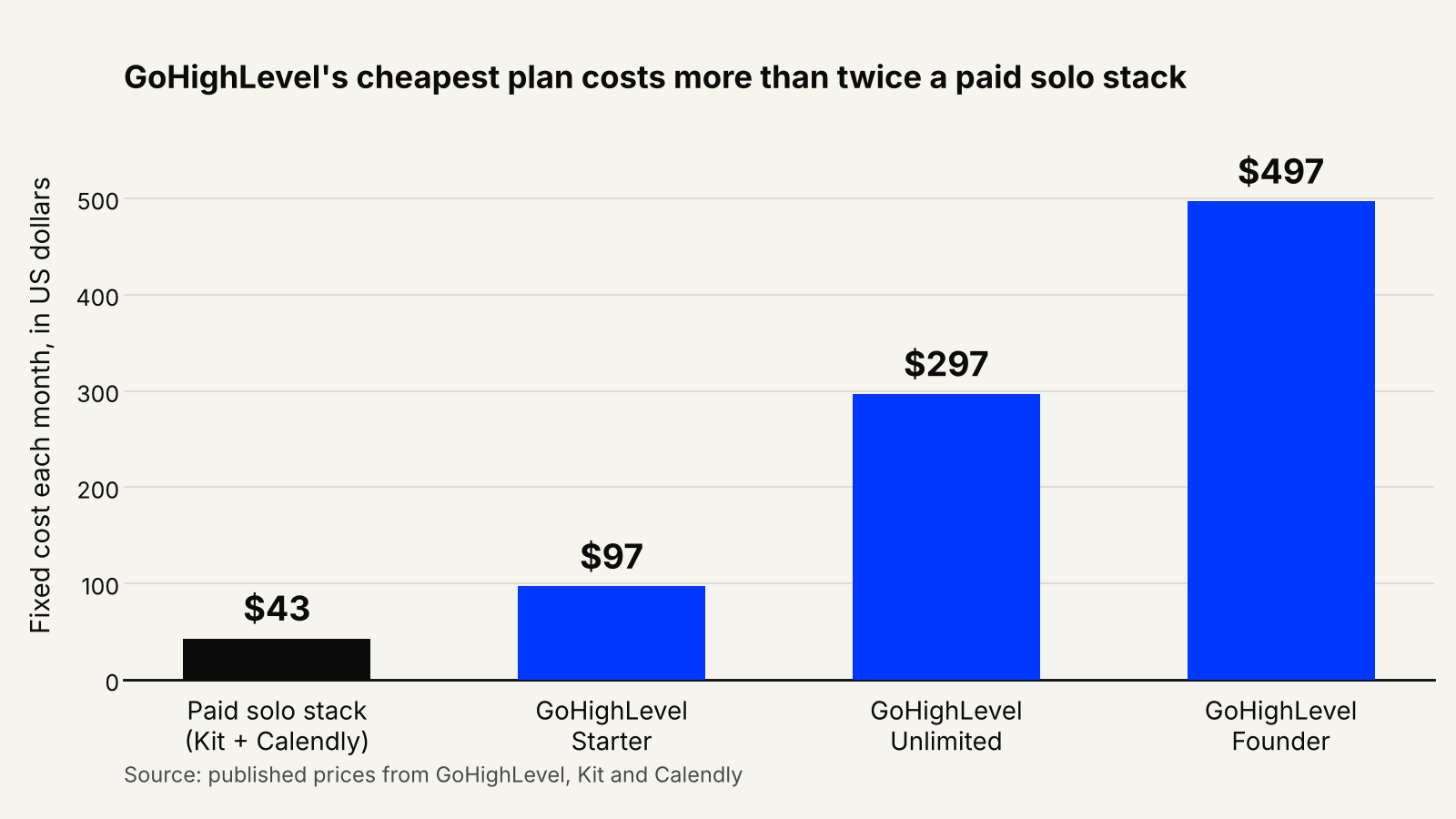
The cheapest is $97 a month. Over a year that is $1,164, before a single text message goes out.
Every plan comes with a 14-day free trial, and GoHighLevel’s own small print notes that usage fees can still apply during it.
| What you pay for | Fixed cost each month | What a business of 1 gets from it |
|---|---|---|
| GoHighLevel Starter | $97 | The whole platform, capped at 3 sub-accounts you will not use |
| GoHighLevel Unlimited | $297 | Unlimited client sub-accounts, plus passing usage charges to clients |
| Email marketing (Kit free plan) | $0 | Broadcasts and sequences up to 10,000 subscribers |
| Scheduling (Calendly free plan) | $0 | 1 event type on 1 connected calendar |
| CRM (HubSpot free) | $0 | Contacts, deals and notes for up to 2 users |
| Payments (Stripe) | $0 | Card payments at 2.9% plus 30 cents, with no monthly fee |
Your Usage Bill Is Far Smaller Than The Reviews Warn
Every review warns about the fees stacked on top of the subscription. GoHighLevel puts it this way on its pricing page. The subscription covers the platform, and phone numbers, text messages, emails and premium AI are charged on what you use.
The rates are all published, so the math is doable - here is one month for a business of 1 with 1,000 email subscribers, emailing weekly.
4,000 emails at $0.675 per 1,000 comes to $2.70. One local phone number is $1.15. Sending 200 text message segments at $0.00747 each is $1.49, plus roughly $0.70 of carrier fees passed straight through. Another 100 minutes of outbound calls at $0.0166 a minute is $1.66.
That is $7.70, so call it $8 a month on top of the $97. The per-segment and per-minute rates are in GoHighLevel’s phone system pricing guide.
So the usage fees are a rounding error at this size. The $97 subscription is the thing you are actually deciding about.
Those per-message rates are for the United States and Canada. GoHighLevel publishes a separate rate sheet by country. Look up 2 figures for wherever your number is registered: the text message rate and the per-minute call rate. Then run the same math on what you send in a normal month.
A Free Stack Covers What A Business Of 1 Actually Sends
Take the jobs GoHighLevel does and price them one at a time.
Kit runs email marketing free up to 10,000 subscribers. Calendly’s free plan gives you 1 event type on 1 calendar. HubSpot’s core CRM is free for up to 2 users. Stripe takes 2.9% plus 30 cents on a card payment. It says outright that it has no setup fees, monthly fees or hidden fees.
A business of 1 can cover every one of those jobs for $0 a month in fixed costs.
Paying for the better versions still comes in under GoHighLevel. Kit’s Creator plan at 1,000 subscribers is $390 for the year, or $33 a month. Calendly’s cheapest paid plan is $10 a seat a month. That is $43 against $97.
There is a real trade here. 4 tools means 4 logins, and 4 places where the connection between them can break. 1 subscription means 1 login.
Whether that is worth $54 a month depends on how much is actually moving between those tools. For most businesses of 1 it is a booking page, a form and 1 email sequence. You set that up once and leave it alone.
So write down every job you want software to do for you this month, before you open a single trial. If the list is a booking page, a form and an email sequence, the free plans already cover it.
Ask yourself this
“What would you automate in your first week, and can you write it down right now?”
Put this to yourself before you start any free trial. A blank answer means the software has nothing to do yet.
Recommended next step
Reach Buyers Without An Ad Budget
Software only helps once there are people to put in it. Bring them in without an ad budget, with a system built for a business of 1: How to Market Your Solo Business Without Ads, $199.
Setup Runs 2 To 4 Weeks Before You Have 1 Customer
Both of the detailed review pages ranking for GoHighLevel put full setup at 2 to 4 weeks, and both say the first week is overwhelming. Neither is a first-hand account from 1 person building it alone, so treat 2 weeks as the best case.
Natalia Maganda, a web designer who builds HighLevel backends for coaches and therapists, calls it the best backend she has ever worked with. Then she says this.
“But it’s not plug-and-play.”
Natalia Maganda, web designer for coaches and therapists
She sells HighLevel setup as a service, so she has every reason to say the opposite.
What makes those weeks expensive is what they go into. You are building automations for a volume of customers you do not have yet. On Trustpilot, where GoHighLevel holds 4.9 out of 5 across 15,265 reviews, a 5-star reviewer still writes that “a new user could get lost pretty easy.”
That 4.9 is worth reading carefully, because the Trustpilot profile shows GoHighLevel asks its customers to leave reviews.
Spend those same weeks on 4 real sales conversations and you will learn more than any workflow will tell you. There are organic marketing strategies for a solo business that need no audience and no software to start.
On your own, a booking page, a form and 4 conversations a month will get you the first customers.
With help, you settle the direction and set the business up underneath it over 8 weeks of 1:1 coaching. That is Plan A, built for people with real skills and no business running on them yet. It runs alongside the work you already have - so there is no gap in your income to plan for.
Buy It If You Sell Marketing To Other Businesses
There is a version of this where GoHighLevel is clearly the right purchase.
You run marketing for other businesses. You put 3 of them in sub-accounts on the $97 plan and put your own name on the software. Then you charge each one a monthly fee for it. The platform was built to run exactly that.
It also fits a solo consultant who already has the volume. Say you send thousands of text messages a month and pay for 5 separate subscriptions at $30 each. Then consolidating is a real saving, and the setup weeks pay for themselves.
The question is whether you are already doing those things today, or only expecting to.
GoHighLevel bills month to month and runs a 14-day trial, so being wrong about the subscription costs you $97. Being wrong about the setup costs you 2 to 4 weeks, and those do not come back.
That matters more at this size than it does at an agency. The Federal Reserve’s 2026 chartbook on nonemployer firms covers businesses with no paid employees except the owner. It found they are less likely to be profitable than businesses with staff. A fixed $97 a month reads differently against a business that is not profitable yet.
Key Takeaways
- The plan tiers are priced by how many other companies you run inside the platform. The client sub-accounts, the white-label and the resale features are what the money buys.
- The cheapest plan is $97 a month, or $1,164 a year before a single text message goes out.
- At solo volume the usage fees work out at roughly $8 a month, which makes the subscription the entire decision.
- Email, scheduling, a CRM and card payments are covered by the free plans of Kit, Calendly, HubSpot and Stripe. The paid versions still come to $43 a month.
- Full setup runs 2 to 4 weeks. Those weeks go into automating a volume of customers you do not have yet.
- Buy it when you run marketing for other businesses and charge them for the software. That is the business it was built for.
The Part You Should Not Work Out By Yourself
The software question only comes up once people are already finding you. Working out how they find you is the step this whole decision rests on. It is also the one a business of 1 most often gets wrong alone.
Recommended next step
Market A Business Of 1 Without Paying For Ads
You get an organic marketing system built for 1 person with no ad budget. The work you do this month still brings people in next year. That is How to Market Your Solo Business Without Ads, $199.
Settle The Direction And Launch It In 8 Weeks
If you have real skills and no business running on them yet, we work with you one on one for 8 weeks. You get 16 hours of live 1:1 coaching, the direction settled, the business set up correctly underneath it, and a plan for reaching the buyers you picked. That is Plan A, $3,800 in one payment or 4 monthly payments of $995, and it is application based. Most founders in it are still in a 9 to 5, and it works the same way if you were laid off or you already freelance.
Work Out Which Step Comes First In About 2 Minutes
If you cannot tell whether your next move is the marketing, the offer or the direction itself, we built a free 5-question quiz. It returns 1 next step, plus a second option in case budget or timing changes. It takes about 2 minutes and your email is optional. Take the Help Me Get Started quiz, and if it sends you to the marketing, the system above is where that work is already laid out.