
You audit a company’s data stack in 1 to 2 weeks and give its data lead a ranked list of fixes for failing pipelines, warehouse spend and gaps in ownership.
Pipelines fail without alerting anyone, dashboards show wrong numbers and warehouse bills keep climbing. In a 2023 Monte Carlo survey of 200 data professionals, teams averaged 67 data incidents a month and took 15 hours to resolve each one. Flexera’s 2026 survey found 29% of cloud spend wasted.
The data team spends its week fighting fires and handling requests, so nobody steps back to review the whole stack. Leaders find it hard to judge their own team’s design choices, and hiring a senior data architect takes months.
You learn the stack, the main problems and who owns each system, then quote a fixed fee.
With read-only access, you check pipelines, tests, orchestration, warehouse usage and billing against your checklist.
You present ranked fixes with estimated savings and offer to build the top items as a separate project.
They answer for broken dashboards and for the warehouse bill.
Buyers can weigh your fee against the monthly warehouse bill you aim to reduce.
What buyers pay: One independent consultant charges $3,000 for a 1-week audit of 12 to 20 hours. Modeled US contract rates run $92 to $184 an hour. European consultancies charge €800 to €1,500 a day.
Data leaders ask peers in these groups for help with cost and reliability problems.
There are 4 places to start, in the order most people find their first buyers.
Tell engineers and data leads you have worked with that you now offer a fixed-fee stack audit, and share a sample report.
Build ties with consultancies and data observability vendors that want someone to handle smaller audits or pre-sales assessments.
Attend dbt meetups and data conferences, and present a teardown of a common cost or reliability mistake.
Publish anonymized write-ups of what you found in audits and how much warehouse spend each fix saved.
Every idea has weak spots. These are the ones to test before you spend money.
Ask for read-only, metadata-level access, sign an NDA and a data processing agreement, and work inside the client’s environment.
Interview the team first, credit what works, and describe each fix as a trade-off made under deadline pressure.
Limit the readout to one follow-up call and price implementation as a separate project.
Sell a fixed-fee audit backed by a sample report, and look for buyers through referrals and communities.
Want more ideas like this? Get all 50 remote-friendly ideas free →
Get inspired by the world’s coolest solo businesses, one story at a time. Delivered to your inbox, FREE. Join solo founders around the world getting the playbooks behind businesses run by one person.
You can unsubscribe with one click.
Start-up cost and time to first offer are our estimates. Prices come from the sources above and change over time, so check them before you set yours.
You are good at what you do, and you are tired of building someone else’s dream. But every idea you come up with feels too risky, too vague or too late. In 60 minutes, learn how to turn your skills into a solo business that makes bank so you can build your own dream.
We use cookies to run this site, understand how you use it and play embedded videos. Choose Accept All to allow all cookies, or Customize to pick the ones you allow.
Get 1 short lesson and 1 task a day by email. Finish all 5 and earn 10% off Plan A, our launch program, or the complete toolkit set, your pick.
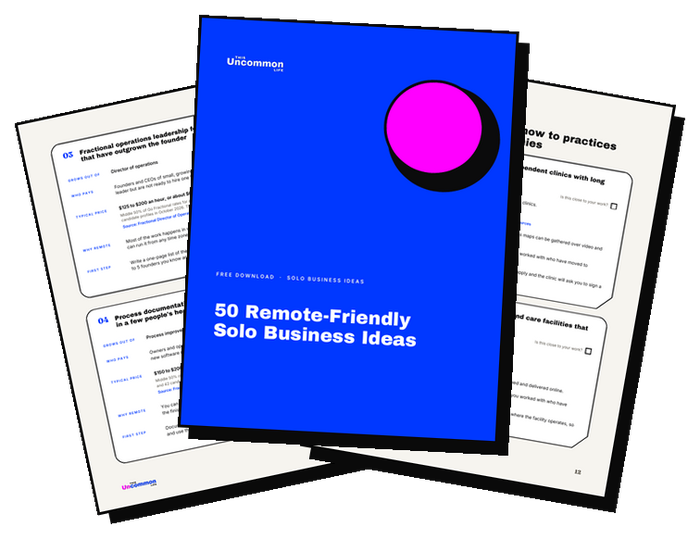
Each idea shows who pays, a typical price with its source, and a first step you can take this week.
Get a quick answer below, or message our team and a real person replies within 2 business days.
Tap a question for a quick answer.
A real person replies within 2 business days.