

Stripe vs PayPal looks like a close call on the published rates. Stripe takes 2.9% plus 30 cents on a domestic card. PayPal takes 3.49% plus 49 cents on its standard commercial line.
Half a percent apart. Then your client pays from Berlin - and the gap triples.
Every comparison ranking for this question gives you those headline rates and a verdict about which suits an online store. None of them prices an actual invoice from a client in another country - the only number that matters when that is your whole business.
So here is that number, with both fee schedules read this week.
Short answer: For a one person business invoicing abroad, Stripe is cheaper and PayPal is faster to get agreed. Billed in the client’s own currency, a $3,000 invoice costs 5.4% through Stripe and 7.99% through PayPal, about $78 apart. Currency conversion drives almost all of that gap, at 1% through Stripe against 3% through PayPal.
The Surcharges Cost More Than The Headline Rate
Both processors advertise a domestic rate and then add to it. The additions are published, and they are the whole story for an international invoice.
| What you are charged | Stripe | PayPal |
|---|---|---|
| Card payment, domestic | 2.9% + $0.30 | 3.49% + $0.49 |
| Card issued outside the US | plus 1.5% | plus 1.50% |
| Currency conversion | plus 1% | 3.00% |
| Sending an invoice | 0.4% of the total, capped at $2.00 | same card rates, no extra |
| A chargeback | $15.00 | $20.00 |
| Standard payout to your bank | free | free |
Those are the United States published rates, read from Stripe’s pricing page and PayPal’s US merchant fee schedule, which carries a last-updated date of November 4, 2026.
If you invoice from outside the United States, open the same two pages for your own country before you price anything. The structure holds everywhere and only the percentages move.
One number on that table does most of the damage. PayPal charges 3.00% to convert a payment into your currency, and Stripe charges 1%. PayPal’s schedule lists a higher 4.00% conversion rate for some other transaction types.
What A $3,000 Invoice Costs You Through Each One
Take a $3,000 invoice to a client in Germany. Two ways to send it, and they do not cost the same.
You invoice in US dollars and the client pays with a German card. You pay the domestic rate plus the international card fee.
Stripe charges 4.4%, which is $132.30. PayPal charges 4.99%, which is $150.19. A difference of $17.89, small enough to ignore.
You invoice in euros, which is what most clients ask for. Now conversion applies on top. Stripe charges 5.4%, or $162.00. PayPal charges 7.99%, or $239.70.
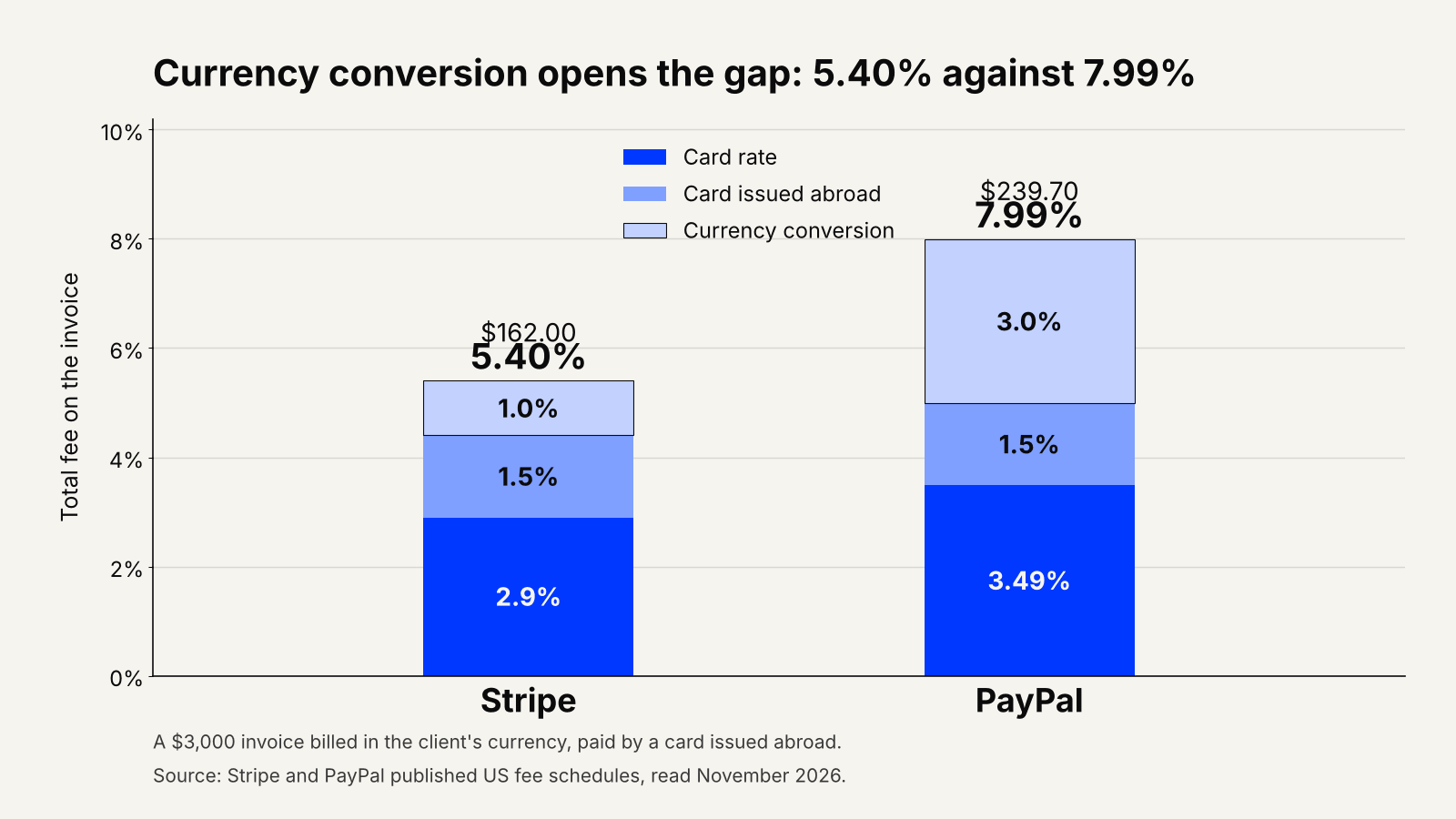
That is $77.70 of difference on one invoice, and it is the conversion fee doing almost all of it. Send two invoices like that a month and the year costs you $3,888 through Stripe and $5,752.80 through PayPal.
The fixed fee per payment is charged in the invoice currency, so it moves a little. It is pennies against the percentages.
Stripe Charges Less And Takes Longer To Set Up
Stripe assumes you have a website or a tool it can sit behind. There is no account to log into on the client’s side, which is the point and also the catch.
Stripe publishes no setup fee and no monthly fee, so the only thing you pay is the per transaction percentage. Payouts on the standard schedule are free. An instant payout runs 1.5%, with a minimum of 50 cents.
The invoicing add-on is the cheapest line in this comparison: 0.4% of the invoice total, capped at $2.00. On a $3,000 invoice, that cap does you a favor.
What it asks of you is an afternoon. You connect a bank account, verify the business, and either use Stripe’s hosted invoices or wire it into whatever you already send invoices from.
If you have never set up a payment processor before, that afternoon is real work.
PayPal Gets You Paid Sooner Because Clients Trust It

PayPal’s advantage has nothing to do with its pricing. Your client already has an account and will pay the invoice today, instead of forwarding it to their finance person and asking what Stripe is.
For a first invoice with a new client in a country you have never billed before, that matters more than $78. A paid invoice at 7.99% beats an unpaid one at 5.4%.
PayPal also has one line that undercuts everything else it does. Pay by Bank, which is ACH, costs 1% capped at $10.00 per transaction. If your client is in the United States and will pay from a bank account rather than a card, that is the cheapest route PayPal offers, and the comparison articles leave it out.
Two costs to watch. A chargeback is $20.00 against Stripe’s $15.00. The optional Invoicing Subscription runs $14.99 a month, which a one person business sending a handful of invoices does not need.
A Bank Transfer Through Wise Undercuts Both On Fees
Neither processor is the cheapest way to get paid from abroad. A bank transfer is, and the comparison articles leave it out because it is not a card processor.
Wise’s business pricing gives you account details in 22 currencies for a one off 31 USD. Receiving a domestic payment in USD, EUR, GBP and several other currencies is free.
Receiving a USD wire or SWIFT payment is 6.11 USD per payment, and converting between currencies starts at 0.23%.
Run the same $3,000 euro invoice through that. Your client pays into your euro account details as a local transfer, for nothing, and converting to dollars starts around $6.90.
The catch is real. Your client has to initiate a transfer, which means their finance team, their approval process and their timeline. You lose the “click here to pay” that settles an invoice the same day.
For a retainer client who already pays you monthly on agreed terms, that is no catch at all.
Recommended next step
Keep More Of Every Invoice You Send
The processor percentage is one of a dozen money decisions that decide if a solo business survives its first year. Running one lean enough that every month you save is a month it keeps working is the subject of How to Maximize Your Runway as a First-Time Solo Founder, at $199.
Skip Both If Your Client Will Pay By Local Transfer
If every client you have is in your own country and pays by bank transfer, none of this applies to you. Use the invoicing you already have and keep the percentage.
Skip the comparison too if you are choosing between these before you have a client. The fee difference on an invoice you have not sent is zero. An hour spent reading fee schedules is an hour not spent finding the person who will pay one.
The decision is worth making properly once international invoices are a regular part of your month. Below that, take PayPal because your client already has it, and change later. Switching processors takes an afternoon.
If the real question underneath this one is what to charge so the fees stop mattering, that is pricing and not processing. Settle it with help if you can. Eight weeks of 1:1 coaching for people with real expertise and no business running on it yet is what the Plan A application is for.
Key Takeaways
- The headline rates are half a percent apart and the surcharges are not. Stripe’s international stack reaches 5.4% and PayPal’s reaches 7.99% on the same invoice.
- Currency conversion is where the money goes, at 1% through Stripe against 3.00% through PayPal, which is most of the $77.70 difference on a $3,000 invoice.
- Billing in US dollars instead of the client’s currency removes the conversion fee entirely, and pushes it onto your client’s card issuer instead.
- Stripe’s invoicing line is 0.4% capped at $2.00, which makes it the cheapest piece of either platform for anybody sending invoices rather than running a checkout.
- PayPal’s Pay by Bank is 1% capped at $10.00 and is the cheapest route PayPal offers for a client paying from a US bank account.
- A bank transfer into Wise account details beats both on fees and gives up same day payment, which suits a retainer client better than a first invoice.
The Part You Should Not Do By Yourself
You now know what the payment rails cost. The harder question underneath is what your business has to bring in each month for those percentages to stop mattering. That is the one people get wrong alone, because they price the fee and never price the month.
Working it out by yourself is possible. It is also how people spend a year optimizing a 2% difference on revenue that was never going to cover their costs.
Start here
Make Every Month You Save A Month That Works
For a first-time solo founder spending their own money, the decisions that outrank your processor choice are what to pay for, what to delay, and what to charge so the margin survives the fees. That is what How to Maximize Your Runway as a First-Time Solo Founder works through, at $199, as an instant download.
Get The Business Chosen, Set Up And Paying You In 8 Weeks
Choose the direction, set the business up correctly underneath it, get the positioning and the offer right, and find the first customers, working one on one with a coach the whole way. That is Plan A, our 8-week application-based program for people with real expertise and no business that runs on it yet. It includes 16 hours of live 1:1 coaching and all 6 Uncommon Toolkits, at $3,800, or 4 monthly payments of $995. Most founders in it are still in a 9 to 5, and it works the same way if you were laid off or you freelance.
See What Your Business Has To Make Each Month
If you cannot yet say what the business needs to bring in, the Solo Founder Roadmap asks 6 questions, takes about 90 seconds, and builds a 12-month plan around your situation and your savings. It is free, and it is the step before Plan A rather than the alternative to it.