

The boring businesses that make money are the ones nobody posts about. Bookkeeping. Proofreading. Documentation. Contract review. The work repeats, the clients are unglamorous, and the service looks the same as it did five years ago.
Search for them online and the results fill up with laundromats, car washes, vending machines and dumpster rentals. Those are real businesses. They are also property, equipment and a crew, which is a different problem.
Here is the gap. Across the six highest-ranking pages for that search, consulting, proofreading and technical writing appear on none.
Bookkeeping is the only expertise-based entry showing up more than once, and not one page cites a source for a single income figure.
So this list runs the other way. Dull service businesses you can start from work you have already been paid to do, with a government figure attached to every one.
Short answer: The boring businesses worth starting on your own are expertise services, where the only asset is a skill you have already been paid for. Bookkeeping, transcript proofreading, technical writing, fractional finance work, regulated translation and contract review support all run from a laptop. None needs employees or premises. What each skill pays as a job is published, and what it pays as a business depends on how narrow you make it.
These Boring Business Ideas Need No Premises And No Staff
Every business below shares four properties. The work is a service, so the only thing you buy is software. Your buyer is a company, so the invoice gets paid.
The need repeats monthly, so one client sold once keeps paying. And an employer has already paid you to do the work, so the skill is proven.
That last property is what separates this list from a laundromat. You skip learning a trade and sell work you have done for years to a smaller buyer who cannot afford you full time.
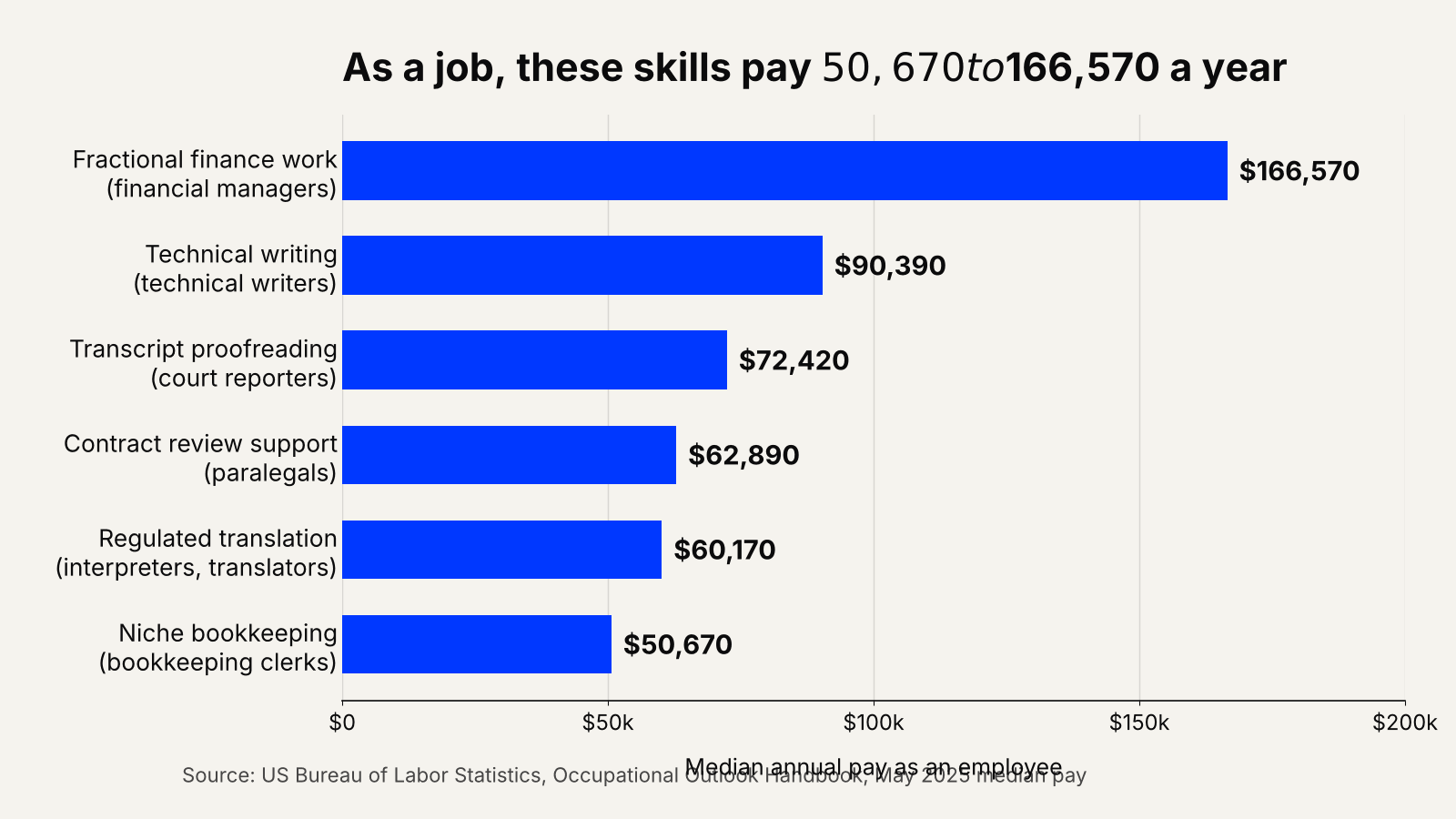
| The business | What the skill pays as a job | Who pays for it | What it takes to start |
|---|---|---|---|
| Bookkeeping for one industry | $50,670 | Owner-run firms under 20 staff | Accounting software and 1 reference client |
| Court transcript proofreading | $72,420 | Freelance court reporters | Style manual training and a tablet |
| Technical writing | $90,390 | Software and hardware companies | 2 writing samples in one subject |
| Fractional finance work | $166,570 | Companies too small for a full-time hire | Your own track record |
| Regulated translation | $60,170 | Law firms, hospitals, agencies | Certification in the pair you speak |
| Contract review support | $62,890 | Solo and small law firms | Familiarity with 1 contract type |
Those pay figures are US Bureau of Labor Statistics medians for May 2025 and describe employees. Read each one as the price the market puts on the skill.
Outside the United States, look up the same occupations at your own national statistics office. The mechanism travels and only the currency changes.
Each One Only Pays Once You Narrow It To One Industry
Here is the part the ranking articles skip. None of these services pays well as a general offer. Each one starts paying when you narrow it to a single industry and learn that industry’s particular mess.
A bookkeeper who works with dental practices knows what insurance receivables look like. A bookkeeper who works with everybody charges what everybody charges.
1. Bookkeeping Pays When You Pick One Industry And Stay In It
Small companies need the books closed every month whether the year was good or bad. That is why the work survives a downturn, and why a client who signs in March is still there in December.
The Bureau of Labor Statistics puts median pay for bookkeeping, accounting and auditing clerks at $50,670 a year as of May 2025, across 1,532,400 jobs. It projects the occupation to shrink 6% by 2035.
Read that decline the right way. Companies are cutting the in-house role, which is exactly why the outside service keeps selling.
Paul Rosenblum formed his freelance bookkeeping business in 1994 and now publishes a newsletter about running one. His client list grew to “10, 15, 30 clients” and then past 100 a year. Some of those clients take about 45 minutes a month.
That is the shape of it. A lot of small, repeating jobs, none of them interesting.
Pick your industry from the one you worked in. If you spent 9 years in construction finance, sell to builders.
2. Court Transcript Proofreading Is Slow, Dull And In Demand
Court reporters produce transcripts under deadline and need a second reader to catch the errors, because nobody proofreads their own work well. The reader is a judge, so the standard is exact.
Nothing on this list proves better that the dull work goes to contractors. BLS puts 33% of court reporters and simultaneous captioners in the self-employed category, the single largest group. Median pay runs $72,420 a year for May 2025 across 19,900 jobs.
Your buyer here is a freelance reporter who already bills the court and needs the pages checked.
Most of the loudest voices in transcript proofreading sell a course about transcript proofreading, which is a different business from the one they describe.
Caitlin Pyle did the work for 2 years before teaching it. She reported over $40,000 from proofreading across 2013 and 2014. That is a real figure from a real practitioner - and also more than a decade old.
So ask any instructor what they currently earn from proofreading rather than from teaching it. The answer tells you which business you are being sold.
3. Technical Writing Pays Most Where The Subject Is Hardest
Every technical product needs an installation guide, an API reference and a compliance document. Engineers can write them and do not want to, which is the whole opportunity.
BLS reports median pay for technical writers at $90,390 a year for May 2025, across only 46,400 jobs. It notes that freelancers in the field take short-term or recurring assignments.
That small job count is the point: a narrow occupation with a steady need beats a crowded one with no barrier.
The rate tracks how hard the subject is to understand. Writing about a payments API pays more than writing about a mobile app, because far fewer writers can read the code.
Worked in a technical field for a decade? You already have the subject. The writing is the part you can learn.
Start with 2 samples in one subject and send them only to companies in that subject.
Recommended next step
Work Out Which Of These You Should Actually Build
Narrow several plausible directions down to the one your own record supports, and leave knowing what has to prove true before you commit. That is what The Shortlist does, live once a week for 60 minutes. It is free and takes no card at registration.
4. Fractional Finance Work Sells Your Title Back By The Day
A company doing $4 million in revenue needs a finance lead and cannot justify a full salary. It buys a few days a month instead.
This is the highest-paid skill on the list by a distance. BLS puts median pay for financial managers at $166,570 a year for May 2025 across 879,700 jobs, and projects 10% growth by 2035. Fractional work is how a company reaches that skill without the salary - and how you reach several companies without the job.
What makes this one boring is the subject matter. Cash forecasting, board packs, lender covenants. Nobody writes a thread about any of it.
One real constraint: this is the business on the list you cannot start without the title. You need to have held the senior role. If you have, the network from your last employer is the first place to ask for an introduction.
5. Translation Pays Where A Mistake Creates Legal Liability
Machine translation took the easy work. What it did not take is the work where a mistranslation creates legal liability: court filings, medical consent forms, immigration paperwork, pharmaceutical labeling.
BLS puts 28% of interpreters and translators in the self-employed category, with median pay at $60,170 a year for May 2025 across 73,900 jobs. Those are the two conditions you want: a market that already hires contractors, and a published rate to price against.
The filter here is certification. Being bilingual only gets you to the door. Court and medical interpreting both run their own credentials, and the credential is what lets you charge a rate no free tool can undercut.
Check which certification your state or country requires for the language pair you actually speak, then price against the published median.
6. Contract Review Support Pays Because Small Firms Cannot Hire
A two-lawyer firm takes on a case that needs 40 hours of document review this month and nothing next month. Hiring is the wrong answer and the lawyers know it.
BLS reports median pay for paralegals and legal assistants at $62,890 a year for May 2025, across 404,900 jobs with no projected change through 2035. Flat demand and flat in-house hiring is the exact condition that sends overflow work outward.

Narrow it to one contract type. Commercial leases, or software licensing, or employment agreements. A firm hiring help for a lease review wants a reviewer who has read 200 leases. You cannot be that reviewer for every document at once.
If you have worked in-house in legal, procurement or compliance, name the contract type you have handled most and offer that one.
Skip This List If You Need Income Within 3 Months
Every business here is a referral business, and referral businesses start slowly. The first client comes from a former colleague or client who already knows your work, and the second comes from the first.
Here is the number worth sitting with. The Internal Revenue Service counted 30,980,966 nonfarm sole proprietorship returns for tax year 2022, reporting $410.7 billion in net income between them. That is roughly $13,255 of profit per return.
Most businesses in that count are side businesses, dormant businesses and businesses nobody ever narrowed. It is still the average, and every list promising $100K a year leaves it out.
Skip the list too if you want the business to be interesting. These are good businesses and dull days - that is the trade, and it is a real one.
Pick The One Your Own Paid Work Already Points At
Choose from your own record rather than from the pay figures above. The question is which one you could sell this week because a client or an employer has already paid you for it.
Write down the last 3 pieces of work you were paid for and name the industry each client was in. Check that against the businesses above.
Where your record and one of these services overlap, that is your direction.
If two or three of them overlap your record and you cannot rank them, that is the choosing problem rather than the working problem. Settle the direction before you build anything, on your own if you can.
Settling it with a coach, and getting the business earning behind it, is 8 weeks of 1:1 work. It is built for people with real expertise and no business running on it yet, and that route has its own Plan A application.
Key Takeaways
- The boring businesses worth your time are expertise services you can start without buying anything, because you already own the only asset they need.
- A general offer in any of these services pays badly. The money starts when you narrow to one industry and learn its particular mess.
- A shrinking in-house occupation is a growing outside service. Bookkeeping is down 6% as a job through 2035, and still bought monthly by every small company.
- The self-employment share tells you whether a market already buys from contractors. It runs 33% in court reporting and 28% in translation, which makes both reachable.
- A published median wage anchors your price and forecasts nothing about your income. It says what the market pays for the skill. What you earn depends on how many clients the work lets you hold.
- The average one-person business clears about $13,255 a year in profit, so treat any list promising six figures without a source as marketing.
The Part You Should Not Do By Yourself
You have a shortlist of dull, durable businesses and a record of paid work to match them against. The step that decides everything now is which one you commit to, and it is the step people get wrong alone, because every direction looks reasonable from the outside and only one of them fits what you have already been paid for.
Working that out by yourself is possible. It is also how people spend 2 years and a lot of money reaching an answer 8 weeks would have given them.
Start here
Leave With One Direction And The Reasons It Won
For anyone holding several plausible business directions and unable to rank them, we run a free live workshop once a week, 60 minutes, 40 of method and 20 of questions. You leave with one direction and the list of what has to prove true before you commit to it. That is The Shortlist, and it is free.
Get The Business Chosen, Set Up And Earning In 8 Weeks
Choose the direction, set the business up correctly underneath it, get the positioning and the offer right, and find the first customers, working one on one with a coach the whole way. That is Plan A, our 8-week application-based program for people with real expertise and no business that runs on it yet. It includes 16 hours of live 1:1 coaching and all 6 Uncommon Toolkits, at $3,800, or 4 monthly payments of $995. Most founders in it are still in a 9 to 5, and it works the same way if you were laid off or you freelance.
Turn The Work You Have Been Paid For Into Directions
If none of the six businesses above matches your record and you cannot yet say who your customer would be, the Solo Business Idea Worksheet takes the skills companies have already hired you for and turns them into 3 or 4 directions in about an hour, across 5 guided steps. It is free, and it is the step before Plan A rather than the alternative to it.