

Leaving a job to start a business comes down to 6 numbers. You can work out every one of them while your salary is still being paid.
Hating your job counts for something. It tells you the job is over. It can’t tell you whether a customer will pay you once you leave.
Timing matters more than courage. In a study in the Academy of Management Journal, founders who started on the side before going full time had a 33 percent lower risk of leaving self-employment. The comparison group went straight from a paycheck into working for themselves.
Short answer: leave once a customer outside your job has paid you and your savings can cover your real monthly costs while you find more. You can do both while you are still employed. You do not need a sabbatical, a career break or a gap in your income to start.
Key takeaways
- Leaving a job to start a business comes down to 6 numbers, and you can work them all out while you are still paid.
- Take your spending from 3 months of statements, because the figure you guess is almost always too low.
- Your employer pays for things your paycheck never shows, and health insurance is usually the biggest one.
- Your savings buy you a number of months, and the business’s costs come out of them too.
- The business has to earn more than your salary, because you pay both halves of the payroll tax.
- Your rate comes from asking 4 people outside your job what they pay to get the problem handled today, then charging one of them for it.
Run 6 numbers before you quit your job to start a business
Work them out in order, because each one feeds the next.
1. Work out what you actually spend each month
You have a number in your head for this, and it is usually too low. The problem is, spending rises with income without you ever deciding it should.
Here is the United States version. The average US household spent $78,535 in 2024, about $6,500 a month, per the Bureau of Labor Statistics Consumer Expenditure Survey.
Your test: add up 3 months of bank and card statements, including annual charges divided by 12. Every other number on this page is built on this one.
2. Add up what your employer pays for you every month
Your paycheck shows what your employer pays you. It leaves out what your employer pays for you - and that figure is bigger than you think.
In the United States, employers spent $49.46 an hour per worker in June 2026, and $15.61 of it went to benefits, per the BLS employer costs release. The biggest piece is health insurance. A single employer plan averaged $9,325 a year in 2025, and the worker paid $1,440 of it, per the KFF Employer Health Benefits Survey.
So your employer’s share, about $650 a month, stops on your last day. Keep the same plan through COBRA and you can pay up to 102 percent of its cost, per the US Department of Labor.
Stella Guan, the founder of This Uncommon Life, worried about health insurance more than anything when she prepared to quit her full-time job.
Outside the United States, find what your employer pays on your behalf (usually health insurance, a pension and social contributions). Price each one as a self-employed person where you live and add it to your monthly number.
3. Check how long your savings can last you
The usual advice is to save 6 months of living expenses. The only thing is, what your employer used to pay and the business’s bills come out of the same savings. So 6 months of expenses buys you fewer than 6 months.
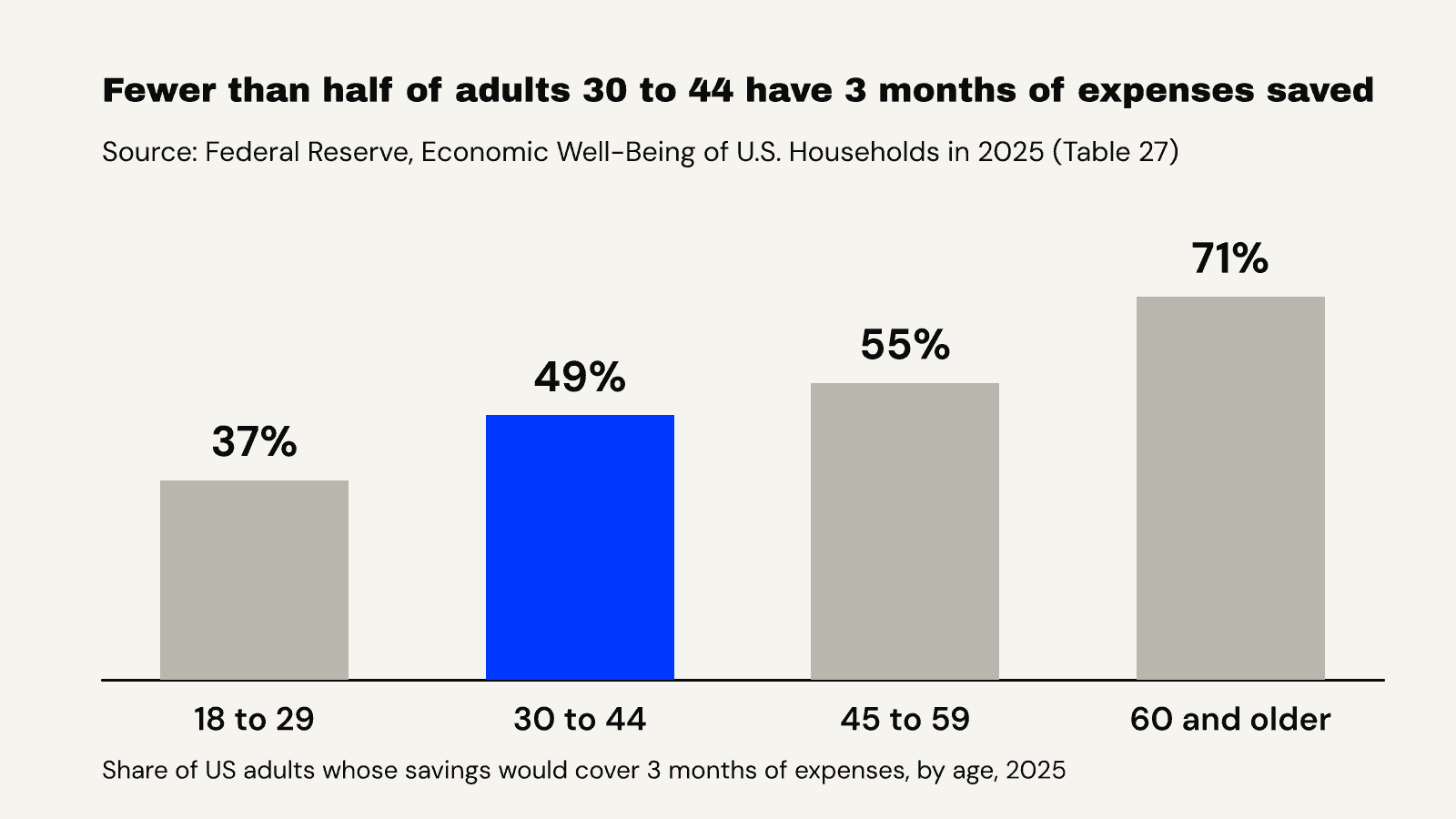
Most of your peers do not have 6 months saved anyway. Fewer than half of US adults aged 30 to 44 have even 3 months set aside, according to the Federal Reserve.
What your savings buy is time to find out whether customers will pay you. About half of new US business establishments are still open after 5 years, per BLS Business Employment Dynamics data.
Your test: divide your savings by your monthly spending plus what your employer covers plus the business’s monthly running costs. Take 3 months off, because your first invoices get paid later than you expect.
Uncommon Toolkit
Keep the business lean enough to last its first year
Keep the business costing less to run than you expect, so your savings buy more months than they would otherwise. That is How to Maximize Your Runway as a First-Time Solo Founder, built for a business of 1.
4. Work out what the business has to get paid each month
The business has to bring in more than your salary did. The reason is a tax line you have never had to look at.
As an employee, you pay half of your Social Security and Medicare tax and your employer pays the other half. Working for yourself, you pay both halves.
| US payroll tax | You pay as an employee | You pay when self-employed |
|---|---|---|
| Social Security | 6.2% | 12.4% |
| Medicare | 1.45% | 2.9% |
| Total | 7.65% | 15.3% |
Self-employment tax applies to 92.35 percent of your net earnings once they reach $400, and income tax sits on top. Elsewhere, look up the self-employed social contribution rate in your own country. The half your employer used to pay becomes yours there too.
Your test: (your monthly take-home pay + what your employer covers each month) divided by 0.75 = what the business has to get paid each month before tax. The 0.75 is a rough stand-in, because your real tax rate depends on where you live.
5. Find out what someone outside your job will pay
This is the number you cannot look up. A salary tells you what an employer pays for your time. It tells you nothing about what a customer will pay for your work.
If a client outside your job has already paid you, start from the largest amount and the number of days you could sell in a month.
Plenty of readers have no such figure. Years of good work inside a job can leave you with skills people want and no evidence that anyone will buy them directly. The number is missing because the question has not been put yet, not because you are not ready to ask it.
So put it. Take the problem you solve to 4 people outside your company, describe it in the words they use for it, and ask what they pay to get it handled today. Those answers are the rate your spreadsheet has been missing.
Then quote one of them a price with a date on it, and charge for the work even if the first amount is small. Only a payment settles this number. If the quote is turned down, you have learned what to change about the price or the offer, and you learned it while the salary was still arriving.
Your test: multiply that rate by the days you could sell in a month and compare it with your monthly target. Book the 4 conversations inside the next 2 weeks.
6. Price what the business costs to run for a year
The business spends money before a customer pays you: registration, an accountant and liability insurance if your work needs it. The software is the line that catches you out, because every tool your employer pays for has a single-user price you have never seen.
Keeping the business lean is the difference between your savings buying 6 months and buying 9. Pricing every tool, cutting what you do not need and keeping the yearly total down is what How to Maximize Your Runway as a First-Time Solo Founder works through.
Your test: price every tool you opened for work this week and add the yearly total to your savings math.
Get your first sales while your salary is still coming in
What the business needs each month and what a customer has paid you so far rarely match. Here is what a first year on your own can look like.
Case study
Alex Styl, a software engineer who went out on his own
Alex Styl wrote up his first year of self-employment line by line. His first software product made about $7 a month until its only customer canceled. An app template sold 41 copies for $680.32, and his book brought in $3,342.74 over 3 months.
He had skills people wanted, and his first year still looked like that.
You can close that gap before you hand in your notice. Give it 2 hours before work, 4 mornings a week, and you put in roughly 400 hours a year.
There is a longer version of this in how to start a business while working full time.
Choosing the direction, and planning how to reach the first customers who might pay for it, is what Plan A does in 8 weeks, alongside your job. It is for professionals with years of experience and no business built on it yet.
Wait if your stock vests or your bonus pays within the year
The 6 numbers can all come out right - and the timing can still be wrong.
Say stock options vest in 8 months or an annual bonus pays in 4. Leaving before then hands your employer money you already earned. That money usually buys you more months than extra saving would.
Choose the business that makes these numbers work
The numbers tell you what has to be true. Choosing the business that makes them true is the step most founders get wrong on their own. Getting it wrong is how a year or two goes by.
Recommended next step
Run a lean business that pays for itself as it grows
Price what the business spends, what it has to earn and how many months your savings buy, on pages you fill in rather than pages you read. That is How to Maximize Your Runway as a First-Time Solo Founder.
Get the business chosen, set up and earning in 8 weeks
You work one on one on the direction you commit to, the business set up correctly underneath it, the positioning and the offer, and a plan for reaching the buyers you named. That is Plan A, our application-based 8-week program for professionals with real expertise and no business running on it yet.
Most founders in it are still in a 9 to 5, and it works the same way if you were laid off or you freelance. The 6 numbers on this page are the first thing we put in front of you.
Work out what you should build, in 60 minutes
Come with too many directions and you leave with one, plus the reasons it beat the others. Come with none and you leave with a method for finding them. That is The Shortlist, our free live workshop for the choosing step on its own, and it is the first step into Plan A.