Can you work remotely from another country while you are sitting there on a tourist entry? That is an immigration question, and it has a different answer in every country you might fly to.
Most of the pages ranking for it come from payroll companies. So they answer a different question: what an employer sorts out about tax when one of its people moves abroad. If you bill your own clients, none of that is yours to solve.
Here is what the rules say in twelve countries, off their own immigration pages.
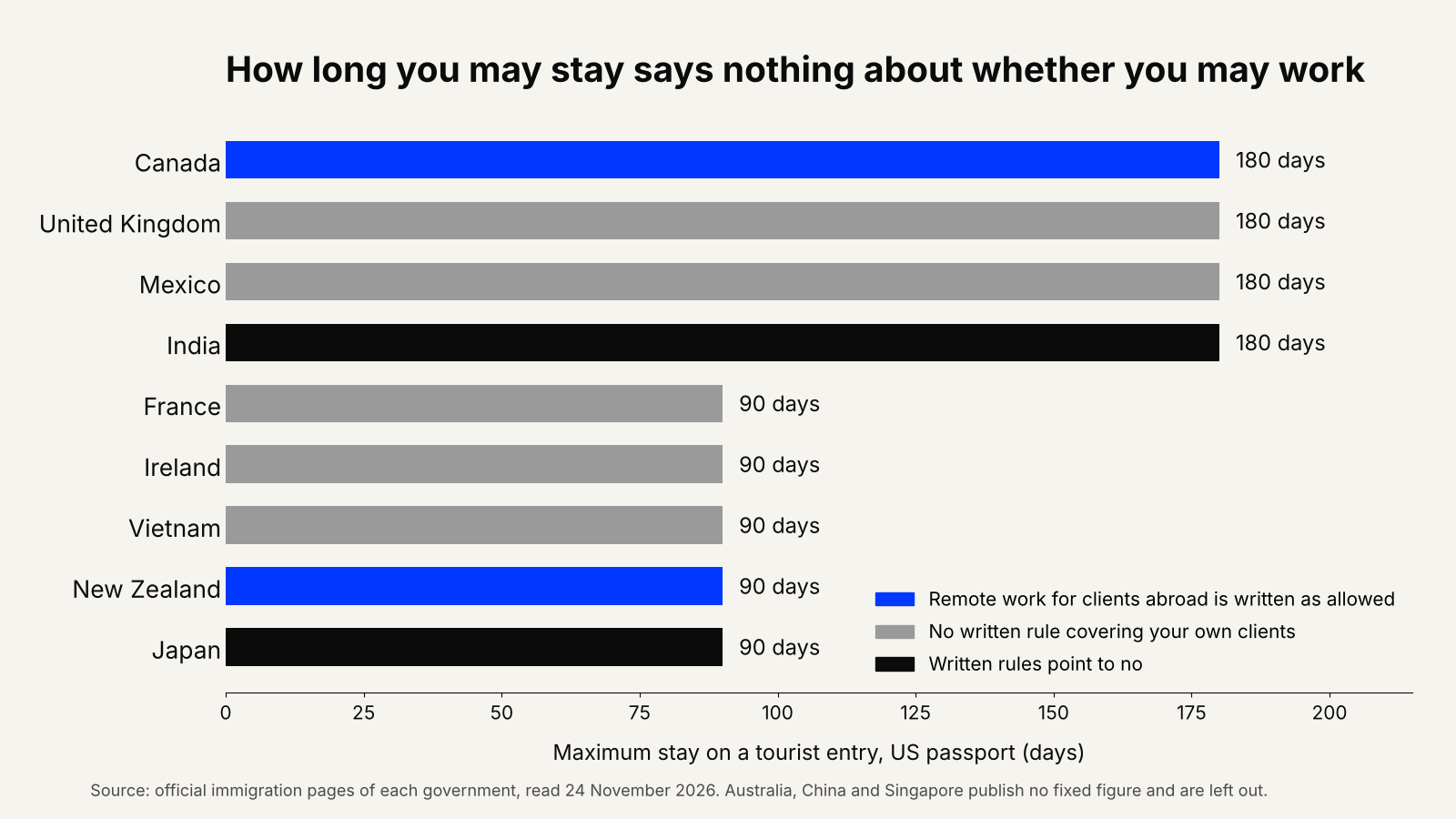
Short answer: It depends on what each country’s rule attaches to. In Canada and New Zealand the rule says you may work remotely for clients outside their borders. In most of the rest there is no rule at all, and an absent rule is no permission. In Australia, China and India the rules point the other way.
You Can Work Remotely From Another Country And Still Break A Rule
These rules do not sort into allowed and banned. They sort by what each one attaches to.
The Canadian and New Zealand rules attach to who pays you. Singapore’s, to who you work for. India’s and Japan’s, to the purpose you declared at the border. China’s, to the ground under your chair. Four countries have no rule to attach.
The table settles one thing straight away: the length of the stay tells you nothing. Canada, Mexico and India all give a US passport 180 days, and the rule on working differs in each.
| Country | What the rule attaches to | Position on your own clients | Longest tourist stay, US passport |
|---|---|---|---|
| Canada | Who pays you | Allowed, self-employed included | 6 months |
| New Zealand | Who pays you | Allowed, no cap on the amount | 3 months |
| Singapore | Who you work for | No work pass needed | Set at the counter |
| United Kingdom | Why you came | Overseas employment only | 6 months |
| France | Nothing | No text exists, says the ministry | 90 days in any 180 |
| Ireland | Nothing | Nothing published | 90 days |
| Mexico | Nothing | Nothing published | 180 days |
| Vietnam | Nothing | Nothing published | 90 days |
| Australia | The act of working | No work, no carve-out | 3 months per entry |
| China | Where you are sitting | Work on Chinese soil needs a Z visa | Set on the visa |
| India | Why you came | One stated purpose only | 180 days a visit |
| Japan | Why you came | Not a listed visitor activity | 90 days |
Canada And New Zealand Have A Written Rule, And It Is A Yes
1. In Canada, serving clients abroad does not count as Canadian work
The clearest wording comes from Canada. Its immigration department’s instruction on digital nomads, updated 26 May 2026, says remote work for a foreign employer “does not constitute entering the Canadian labour market.” It extends that to the self-employed, as long as you serve “clients outside of Canada.” Six months at a time on a US passport. Take on one Canadian client and you need a work permit.
2. Every New Zealand visitor visa now allows remote work
Immigration New Zealand changed its operational manual on 27 January 2025, and the instruction is one sentence: “It is a condition of all visitor visas that the holder may undertake remote work in New Zealand.” The work must not be for a New Zealand employer or need you at a workplace there, and no cap applies. The catch is small and real - remote work alone is not an accepted reason to visit. Three months for a US passport.
In Singapore And The UK The Rules Stop Just Short Of You
3. In Singapore you need no work pass for an overseas client
Singapore’s Ministry of Manpower answers in your own words: “if you are in Singapore and are working for or providing services to an overseas-based organisation or client, you do not need a work pass.” Then look at the seam. The immigration authority bars a short-term visit pass holder from “any form of employment (paid or unpaid), business, profession, or occupation in Singapore.” Both survive because that says in Singapore, and your client is elsewhere.
4. UK rules allow remote work only if it is not why you came
Since 31 January 2024 the visitor rules have let you “undertake activities relating to their employment overseas remotely from within the UK,” on one condition: “providing this is not the primary purpose of their visit.” Where a visit only holds together because you are earning there, caseworkers count the work as the primary purpose. Note the words employment overseas. Your own client list is nowhere in that rule, and a separate paragraph bars “running a business as a self-employed person.” Six months on a US passport.
The test
“Is anyone inside this country paying me for this work?”
Ask it before you book a flight. Every written answer here turns on it, except China, which looks at where you are sitting.
France, Ireland, Mexico And Vietnam Have No Rule On Remote Work
“We all know it’s illegal, but nobody cares to speak up about it.”
Pieter Levels, founder of Nomad List, writing in 2017
That was 2017. For two countries on this page it has stopped being true since. For these four it has not.
5. France’s own ministry says no rule on this exists
Asked in parliament about foreigners teleworking from France, the Interior Ministry answered on 23 June 2026: “Il n’existe aucun texte relatif au droit du séjour des ressortissants étrangers en télétravail sur le territoire français.” No text exists on the residence status of foreigners teleworking on French soil. The same answer counts a teleworker paid and taxed abroad as non-actif, outside the French labour market, which leans toward tolerance. It was written about a long-stay visitor card, though, and not about the 90 visa-free days a US passport gets.
6. Ireland’s only written condition is a flat no to work
No Irish page covers remote work for a foreign client, and the search is the finding. The one condition on point sits in the immigration service’s visit FAQ, for short stay visa holders: “You do not work (any type of paid or unpaid work).” It draws no line by who pays you or where they sit. A US passport does not need that visa anyway - two layers of silence.

7. The Mexican rule covers money you receive inside the country
A US passport gets the visitante sin permiso para realizar actividades remuneradas, the visitor with no permission to carry out paid activities. The rules say the officer grants 180 days. The guidance implementing the law describes it as being in Mexico “sin recibir ninguna remuneración económica en el país,” without receiving any payment in the country. Those last three words point somewhere useful - and no Mexican rule mentions remote work.
8. Vietnamese work rules assume a Vietnamese employer every time
Vietnam issues visas by declared purpose. Its foreign ministry lists the tourist symbol in one line: DL “is issued to tourists.” The decree covering foreign workers defines them through a list assuming a Vietnamese employer or contract every time. On a tourist e-visa serving clients abroad, you fall outside both texts rather than inside either. Treat the gap as a gap.
Recommended next step
Build Income That Follows You Across Borders
Every rule here turns on money arriving from outside. Settling what you sell and getting the first clients paying for it is what Plan A works through, one on one, in 8 weeks.
In Australia, China, India And Japan The Rules Point The Other Way
9. An Australian visitor visa does not let you work at all
Home Affairs is blunt: “A Visitor visa or Electronic Travel Authority (ETA) does not allow you to work in Australia.” The same page adds that a visitor who works there “is doing so illegally.” It carves out nothing for an overseas employer or client, and nothing else the department publishes does. There is no Australian digital nomad route, so no tidy legal way to do this one.
10. China’s test is where the work happens, whoever the client is
The Chinese no is the firmest, and the reason matters more than the verdict. The employment rules there regulate “acts of foreigners without permanent residence status to engage in remunerative work within Chinese territory.” The test is the place the work happens. A laptop open in a Shanghai hotel room is inside Chinese territory even when every client and every dollar sits outside it.
11. India’s tourist visa allows one purpose and no other activity
India’s policy works as a closed list rather than a ban. A tourist visa is granted to a foreigner “whose sole objective of visiting India is recreation, sight seeing” and a short run of similar things, “and no other purpose/ activity.” Client work is another activity. The e-visa page adds that it “is not allowed for employment.” Neither page uses the words remote work, so the bar comes out of that purpose clause.
12. Japan’s list of visitor activities does not include working
Temporary visitor status covers a fixed list: sightseeing, recreation, sports, visiting relatives, observation, training, meetings, business liaison and similar. Remote work is absent, and the foreign ministry ties visa-free entry to not being “engaged in income-earning activities.” The strongest signal sits elsewhere: a six-month digital nomad status open since 31 March 2024, with an income threshold of 10 million yen. An odd route to build if the 90-day visitor entry already covered it.
Skip All Of This If One Employer Controls Your Income
None of this is legal advice and none of it is settled. Several of these rules are under three years old, and some do not exist. One clause on status: if your right to stay where you live now runs through your employer, that is a question for an immigration lawyer.
These rules leave three things untouched. Tax residency is a separate regime with its own thresholds. Your client contracts may say where the work has to be performed. And your own country takes its own view.
There is no national US rule either. A review in the Georgetown Immigration Law Journal found that Customs and Border Protection has “not clarified whether visitors violate their B visa status if they work remotely for foreign employers.” Its conclusion: “no completely safe U.S. temporary visa option for most international digital nomads today.”
Pick the one country you actually want, open that government’s own page rather than a relocation company’s, and write down what its rule attaches to. That tells you whether you are reading a permission, a prohibition or a blank.
And if nothing yet pays you from outside any of these countries, that is the thing to fix first. The country becomes a choice after that. Getting from expertise you already have to a business billing its own clients is the work Plan A takes on in 8 weeks of 1:1 coaching.
Key Takeaways
- Only the Canadian and New Zealand rules say in writing that you may work remotely for clients outside their borders while visiting.
- In most of these countries no rule covers remote work at all, and a missing rule hands you no permission.
- Australia, China and India have rules pointing the other way, and China’s turns on where you are physically sitting, whatever address your client has.
- The length of a tourist stay tells you nothing about whether you may work during it: Canada, Mexico and India all give 180 days and the rule on working differs in each.
- Every written rule here comes down to whether anyone inside that country is paying you.
- The income has to be yours before the country is a real choice, since all of these rules turn on money arriving from outside.
The Part You Should Not Work Out By Yourself
Every rule on this page turns on one fact: whether the money reaching you comes from outside the country you are sitting in. Building income that answers to your own clients is the step people get wrong on their own. The rest of this depends on it.
Recommended next step
Own The Income Before You Pick The Country
For people with years of expertise and no business running on it yet: in 8 weeks you settle the direction, set the business up underneath it, and leave with an offer and buyers to approach. That is Plan A, 16 hours of 1:1 coaching, $3,800.
Work Out What You Should Build, In 60 Minutes
If you have several business directions and cannot rank them, we run a free live workshop once a week. A few people get their list narrowed to one on the spot, and everyone leaves with the method for doing it themselves. If you have no direction yet, you leave knowing how to generate them properly. That is The Shortlist, and it is the way in to the eight weeks above, where the business actually gets built.